
Why the Sphynx is hairless: origins, genetics and the standard
From a kitten called Prune in Toronto to today's breed: where the Sphynx came from, which gene removes the coat and whether these cats are really bare.
Published 4 min read

The Sphynx is one of the most recognizable cat breeds in the world, and almost everyone who sees one for the first time asks the same question: why no fur? The answer is simple and fascinating at the same time. It is a natural genetic trait that people noticed a few decades ago and then fixed in a breed. Here is how that happened, what goes on in the genes and what being hairless means for the cat itself.
From Prune to a modern breed
Hairless kittens had occasionally been born to ordinary cats before, but the story of the modern Sphynx began in Toronto, Canada, in 1966. A black-and-white domestic cat gave birth to a hairless kitten named Prune, after his wrinkled skin. Enthusiasts tried to develop this line and established that the trait was recessive, but the gene pool was too small and breeding eventually stopped.
The breed really took off thanks to later discoveries:
- in 1975, hairless kittens named Dermis and Epidermis were born to ordinary farm cats in Minnesota, USA;
- in 1978, again in Toronto, a non-pedigree cat produced a hairless male called Bambi, and later two more hairless kittens, Punkie and Paloma.
Today's Sphynx cats descend from these animals. To widen the gene pool, breeders crossed them with other cats, including Devon Rex, and later with domestic shorthairs. The CFA accepted the breed for registration in 1998 and granted it championship status in 2002.
What happens in the genes
The Sphynx coat is switched off by a change in a gene called KRT71. It codes for keratin 71, a protein needed for a hair to form properly inside the follicle. Because of the mutation, the hair that forms is weak, breaks easily and falls out, leaving little more than a barely visible fuzz.
A few key points in plain words:
- the trait is recessive: a kitten is hairless only if it inherits the Sphynx copy of the gene from both parents;
- a Sphynx crossed with an ordinary cat produces coated kittens, which are simply carriers;
- the same gene is responsible for the curly coat of the Devon Rex: researchers at UC Davis showed that these are different versions of one gene, with the Sphynx version dominant over the Devon one.
That is why breeders today use a DNA test to make sure no hidden Devon variant remains in their Sphynx lines.
Not quite bare: what the standard says
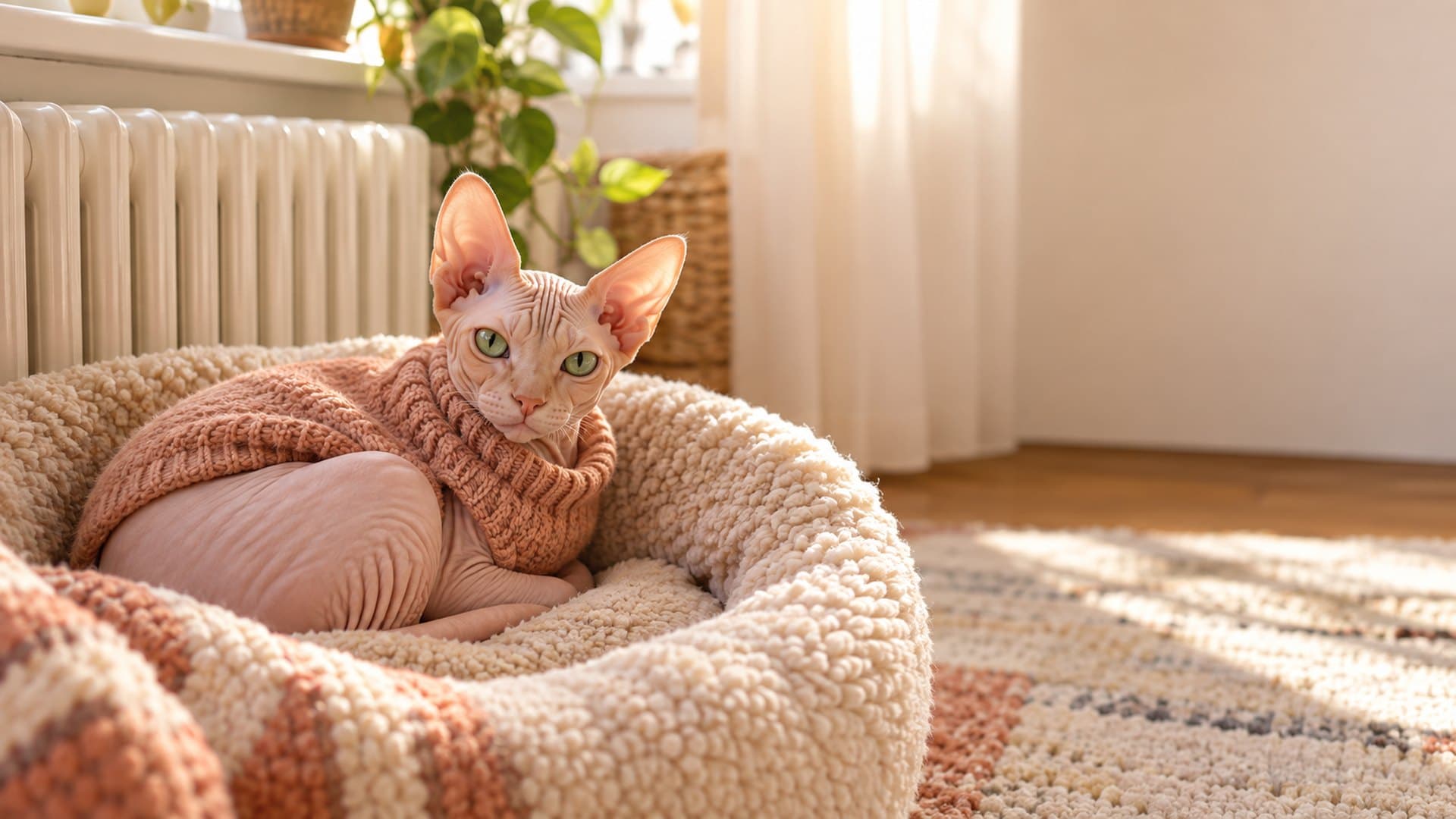
A Sphynx only looks completely naked. According to the breed standard, the skin feels like chamois leather, and the body may be covered in a very fine down that is almost invisible to the eye. Short, soft hair is allowed on the ears, muzzle, tail and feet. Whiskers and eyebrows may be short, broken or missing altogether.
Other features of the breed:
- medium size, a sturdy muscular body and a rounded belly;
- a modified wedge-shaped head with rounded contours, prominent cheekbones and whisker pads;
- large ears that are wide at the base, and big lemon-shaped eyes;
- wrinkles, especially on the head and around the shoulders.
The covering can change with age, season and hormones: some cats grow a little more down in winter, and the down sometimes becomes thicker after neutering. Kittens born with down may grow a little more as they mature, while those born without it usually stay that way.
All colors and patterns are allowed in the breed, and on a Sphynx you can see them right on the skin: the pigmented skin mirrors the color the coat would have had.
Other hairless cats are not Sphynx
The Donskoy (Don Sphynx) and the Peterbald are hairless too, but their hairlessness has a completely different genetic origin: it is dominant and can show up in different ways, including gradual hair loss with age. These breeds are not compatible with the Canadian Sphynx, and responsible breeders do not mix them.
What being hairless means for the cat
Fur is not just for looks. It keeps a cat warm, protects it from the sun and scratches, and absorbs the oils the skin produces. Without it, a Sphynx gets cold faster, can get sunburned, and oils build up on the skin, in the ears and around the claws. That is why a Sphynx needs a warm home and regular care.
It is also worth knowing that some cat welfare organizations, including International Cat Care, consider breeding hairless cats undesirable precisely because a coat matters so much to a cat. If you choose a Sphynx, look for a breeder who puts health before looks, and be ready to make up for the missing coat with warmth and care. We cover this in Sphynx skin care and Sphynx health.
Find out more on the breed page. Check whether there are kittens of this breed right now, or join the waiting list.