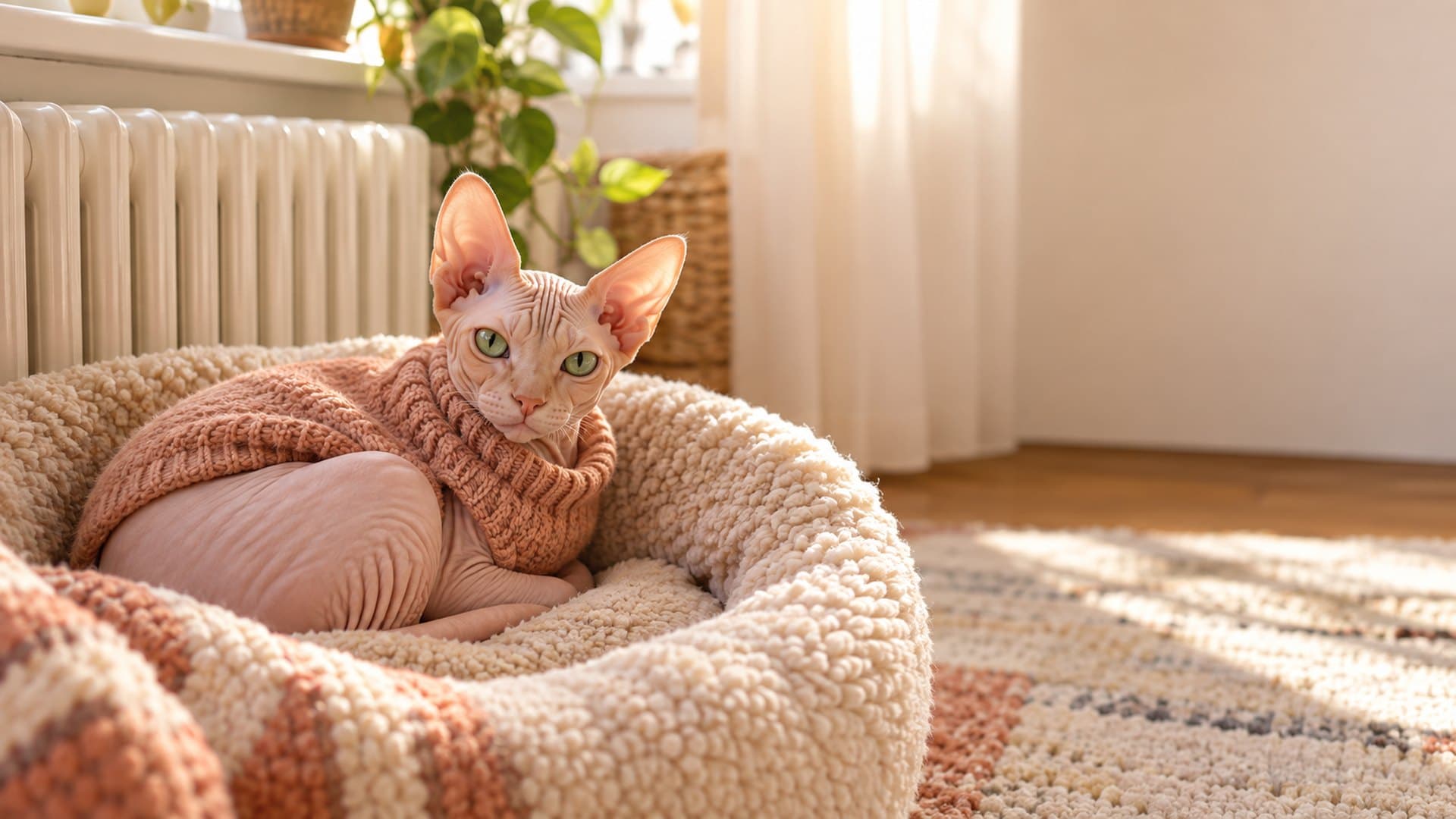

Seven Sphynx myths and what is actually worth knowing
Hypoallergenic, no grooming needed, hotter than other cats? We look at popular claims about the Sphynx and explain what is really true.
Published 4 min read

The Sphynx has gathered plenty of legends: some credit it with magical hypoallergenic powers, others with a mysterious Egyptian ancestry. Some of these ideas are just amusing, but others can lead people to the wrong decision. Here are seven popular claims and what we actually know about them.
“Sphynx cats are hypoallergenic”
This is the most common myth and the most important one. The main cat allergen, a protein called Fel d 1, is not made in the fur. It is produced in the skin's sebaceous glands and in the salivary glands. A cat spreads it over its body while grooming, and from there it ends up on furniture, fabrics and in the air. Fur is just one of the ways it travels.
The American College of Allergy, Asthma and Immunology (ACAAI) states plainly that all cats produce allergens and that studies have not shown any cat to be hypoallergenic. Allergen levels vary from cat to cat, so one allergic person may react less to a particular Sphynx, while another reacts just as strongly as to any other cat. Small studies have found less Fel d 1 on the coats of some breeds sold as hypoallergenic, but no breed guarantees that there will be no reaction.
If someone in your family has allergies, talk to an allergist and, if possible, spend some time around adult cats of the breed before deciding.
“A Sphynx is completely bare”
Not quite. Sphynx skin is often compared to a peach or to chamois, because it is covered in a very fine down. There may be short hair on the nose, ears, tail and feet, and in the cold season some cats grow noticeably more down. Whiskers can be short, broken or missing entirely.
“No fur means no grooming”
In fact, it is the opposite. A Sphynx's sebaceous glands work just like any other cat's, but the oil has nowhere to go: without fur, it stays on the skin and collects in skin folds, around the claws and in the ears. So a Sphynx needs regular baths or wipe-downs, ear cleaning and claw care. How often to bathe depends on the individual cat: veterinary dermatologists at Texas A&M note that a Sphynx usually needs a bath no more than once every one to two weeks, and that bathing too often dries the skin out. We explain how to make it stress-free in Sphynx skin care.
“A Sphynx runs hotter than other cats”
A Sphynx does feel hot, but its body temperature is the same as any other cat's. There is simply no layer of fur between your hand and its skin to hold the warmth in. They really do get cold faster, though, because heat escapes easily from bare skin, so a warm corner and a blanket are a need rather than a luxury. The practical takeaway: if your Sphynx seems unusually hot or lethargic, go by its behavior rather than by how it feels to your hand, and contact your vet if in doubt.
“The Sphynx is an ancient Egyptian breed”
The name does nod to the Great Sphinx of Egypt, but the breed itself is young and comes from North America. Today's Sphynx cats descend from hairless kittens born to ordinary cats in Toronto and Minnesota in the 1960s and 1970s. Read more in Why the Sphynx is hairless.
“Sunbathing and outdoor time are good for a Sphynx”
Sphynx skin has no protection from ultraviolet light, so these cats can get sunburned, pale-skinned cats especially. Cold is also more dangerous for them than for their furry relatives. That makes the Sphynx an indoor cat: sunbathing on a windowsill in moderation, a warm bed, and outdoor time only under supervision, in mild weather and briefly. Only use sun protection products your vet recommends, because some human sunscreens are harmful to cats if licked off.
“All hairless cats are Sphynx”
The Donskoy and the Peterbald are hairless too, but their hairlessness has a different genetic origin and is inherited differently. They are separate breeds and are not compatible with the Canadian Sphynx for breeding. In these breeds, for example, kittens may be born with a coat and lose it gradually, whereas a Canadian Sphynx is hairless from birth. So when choosing a kitten, check exactly which breed you are talking about and ask for pedigree papers.
In general, rely on breed standards from cat registries, information from veterinary schools and your own vet's advice. As for a particular kitten's personality, the breeder who has known it since birth is your best source.
Find out more on the breed page. Check whether there are kittens of this breed right now, and if not, join the waiting list.