

Why the Somali is longhaired: the breed's story and the long-hair gene
How fluffy kittens appeared among Abyssinians, what a recessive long-hair gene means, and why a Somali's coat only fully develops at 18 months to two years.
Published 4 min read
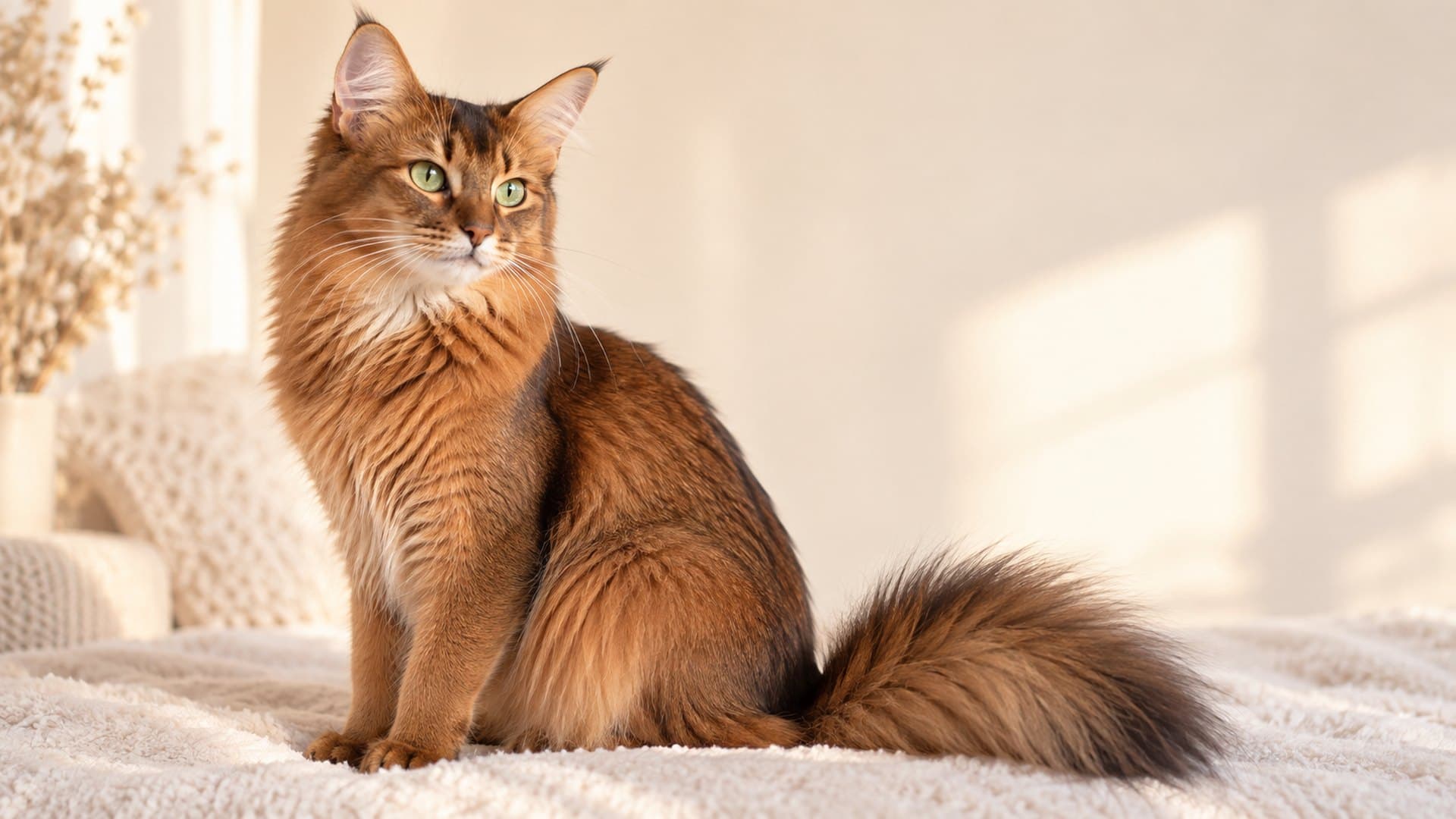
A Somali looks like an Abyssinian that has decided to put on a luxurious coat: the same ticked colouring, the same large ears and expressive eyes, but with soft, semi-long fur, a ruff and a bushy tail. The resemblance is no accident, because the Somali grew up right inside the Abyssinian breed. Here is how that happened and what genetics and breed standards say about the long coat.
Abyssinians with a surprise
In the mid-20th century, fluffy kittens began turning up now and then in Abyssinian litters. According to the account given by the Cat Fanciers' Association (CFA), the long-hair gene may have entered the breed after the Second World War, when very few Abyssinians were left and cats of not entirely known ancestry were used to rebuild the breed. Because the gene is recessive, it passed silently from carrier to carrier for years and only showed up when two such cats were mated.
At first the longhaired kittens were seen as undesirable and quietly placed as pets. It was only in the 1960s that a few breeders decided they were looking not at a fault but at a new breed.
How the name and recognition came about
The driving force was the American breeder Evelyn Mague. In the mid-1960s she bred a longhaired Abyssinian called George, and she proposed naming the new breed Somali, after Somalia, the neighbour of Ethiopia, formerly Abyssinia. Together with breeders in Canada she began working on the breed systematically.
Recognition followed gradually. The CFA accepted Somalis for registration in the 1970s and granted championship status in 1979. The first Somalis arrived in the UK in 1980, and the Governing Council of the Cat Fancy (GCCF) granted them championship status in 1998.
The genetics in plain words
Coat length in cats is controlled by a gene called FGF5, which normally signals the hair to stop growing. In 2007, geneticists described several variants of this gene that disrupt its function, so the hair keeps growing for longer. All of these variants are recessive, which means a cat is longhaired only if it inherits such a copy from both parents.
In practice, this means:
- two Somalis can only have longhaired kittens;
- an Abyssinian and a Somali produce shorthaired kittens that carry the gene;
- two carrier Abyssinians can expect roughly a quarter of their kittens to be longhaired.
That is why Abyssinians and Somalis are often seen as two branches of one family, and some associations register shorthaired carriers from Somali lines under separate rules.
These details matter in practice too: a kitten from two Somalis will definitely be fluffy, while if a “Somali” is offered from two shorthaired parents, it is worth studying the pedigree carefully and asking the breeder questions.
Ticking on a long coat
A long hair has room for more bands of colour than a short one, so a Somali's coat looks deep and iridescent. But it develops very slowly. The CFA specifically notes that Somalis are extremely slow to show mature ticking. Kittens are often born dark and almost solid-coloured, and the full coat, ruff, breeches and tail may take 18 months to two years to develop.
A Somali's coat can also change with the seasons: the ruff and breeches are usually fuller in winter, and after the spring moult the cat can look noticeably “slimmer”. This is normal, although any bald patches or a dull coat are a reason to see the vet.
What the standards say
In build, the Somali mirrors the Abyssinian: medium-sized, lithe and muscular, with a moderately wedge-shaped head, large ears and almond-shaped eyes outlined in a dark rim. The difference is the coat: soft, very fine and dense, with a ruff at the neck, breeches on the hind legs and a full, brushy tail that tapers from a thick base. It is this tail that earned the breed its nickname, the “fox cat”.
As for colours, the CFA recognises four: ruddy, red (called cinnamon by the CFA and more often sorrel in Europe), blue and fawn. The GCCF lists 28 colours, including silver varieties. For a pet, small deviations from the standard, such as a slightly paler tail or a less impressive ruff, make no difference: they matter only for shows and breeding.
Shared ancestry, shared tests
Because Somalis and Abyssinians share their ancestors, they also share inherited risks. DNA tests exist for pyruvate kinase deficiency and for two forms of progressive retinal atrophy (rdAc and Rdy), and responsible breeders test their breeding cats. You can read more about these conditions in our article on Abyssinian health; discuss anything to do with an individual cat's health with a vet.
To see that “fox” tail in real life, visit the breed page and the kittens of this breed section. If there are no kittens right now, join the waiting list.


