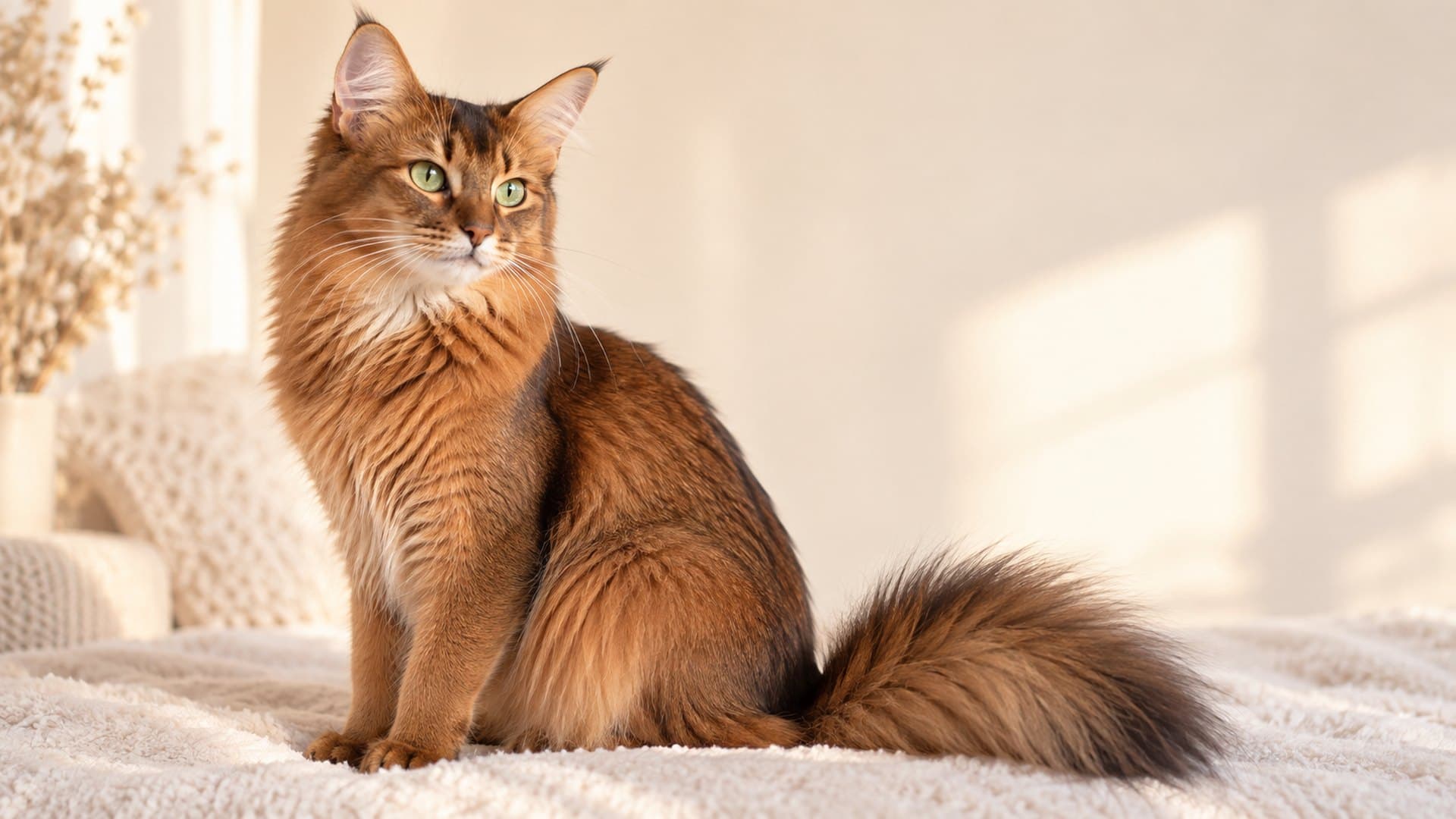

Grooming a Somali: the ruff, the breeches and the fox tail
How much time a Somali's semi-long coat takes, which tools you need, how to comb the tricky areas and what to do during the moulting season.
Published 4 min read

A Somali's fluffy coat looks as if it needs a full beauty salon. In reality it is easier to care for than it seems: the fine, semi-long coat rarely mats, and most cats need just one thorough comb-through a week. The key is knowing which areas to focus on and getting your kitten used to the comb from an early age. Here is how to organise grooming without stress for either of you.
What a Somali's coat is like
The Cat Fanciers' Association (CFA) describes the Somali coat as soft, very fine and dense. It is medium length on the back, forms a ruff at the neck and breeches on the hind legs, and the tail is full and tapers from a thick base. The CFA notes that weekly combing is usually enough to remove dead hair and keep shedding under control. The UK's Governing Council of the Cat Fancy (GCCF) stresses a gentle touch: the coat should be combed softly so it does not tangle.
Remember that a Somali's full coat develops by 18 months to two years, so a kitten's fur is still shorter and easier to manage. That makes kittenhood the best time to get your cat used to the comb and to having its paws, ears and tail touched.
The tools you need
You do not need a big kit. For long coats, International Cat Care recommends a basic set:
- a wide-toothed comb, your main tool;
- a finer-toothed comb for the breeches, behind the ears and checking for fleas;
- a rubber grooming glove to pick up loose hairs at the end;
- optionally, a soft brush for a final polish.
Choose tools with rounded tips and test them on your own hand: if something is unpleasant for you, it will be unpleasant for your cat too.
Combing step by step
Pick a moment when your cat is calm and relaxed, for example after play and a meal. Then:
- gently massage the skin with your fingers against the direction of hair growth to lift dead hairs;
- comb the back and sides with the wide-toothed comb from head to tail;
- work separately and very carefully on the ruff, the armpits and the inside of the hind legs, where the skin is thin and the fur tangles most often;
- comb the tail gently, section by section, without pulling hair out, because a full tail grows back slowly;
- finish with the rubber glove and always give your cat a treat.
Do not try to do everything in one go. Today the back and tail, tomorrow the breeches. Your cat should know it can walk away if it feels uncomfortable. If your kitten wriggles, do not scold it: it is better to end the session after two strokes of the comb and a treat than to turn grooming into a struggle your cat will remember for a long time.
Mats and moulting
Tease a small mat apart gently with your fingers, a few hairs at a time, holding the fur close to the skin. Never cut mats out with scissors: it is easy to injure the skin in tightly matted fur. If there are many mats or they are large, see a vet or an experienced groomer. Mats most often form where fur rubs: under the front legs, behind the ears, on the breeches, and under a harness if your cat wears one.
Somalis shed more noticeably in spring and autumn. At these times, comb your cat more often: two or three times a week, or in short daily sessions. That way less hair ends up in the stomach during grooming. If your cat often brings up hairballs, tries to and cannot, is constipated or is off its food, take it to the vet.
Baths: rarely
A healthy Somali usually does not need bathing. The CFA notes that a bath may be needed before a show or when a particular cat's coat quickly becomes greasy. Always comb the coat before a bath, because water makes even small mats tighter. Use only a cat shampoo, rinse it out thoroughly and dry your cat in a warm, draught-free room: a dense coat takes a long time to dry.
Teeth, ears and claws
The GCCF advises keeping an eye on tartar in Somalis. The best prevention is brushing with cat toothpaste, introduced to your kitten gradually, plus regular dental checks with your vet. Human toothpaste is not suitable for cats.
Check the ears once a week: they should be clean, with no dark debris or smell. Claws usually wear down on scratching posts, and if needed the tips can be trimmed carefully with cat clippers. The fur between a Somali's toes can be long too, so check for small mats there. It helps to combine checking the ears, teeth and claws with the weekly comb-through: nothing gets forgotten, and your cat gets used to a predictable routine.
Any skin changes, redness, dandruff or bald patches are a reason to see the vet: diagnosis and treatment are their job.
Find out more on the breed page. You can browse available kittens of this breed, and if there are none right now, join the waiting list.