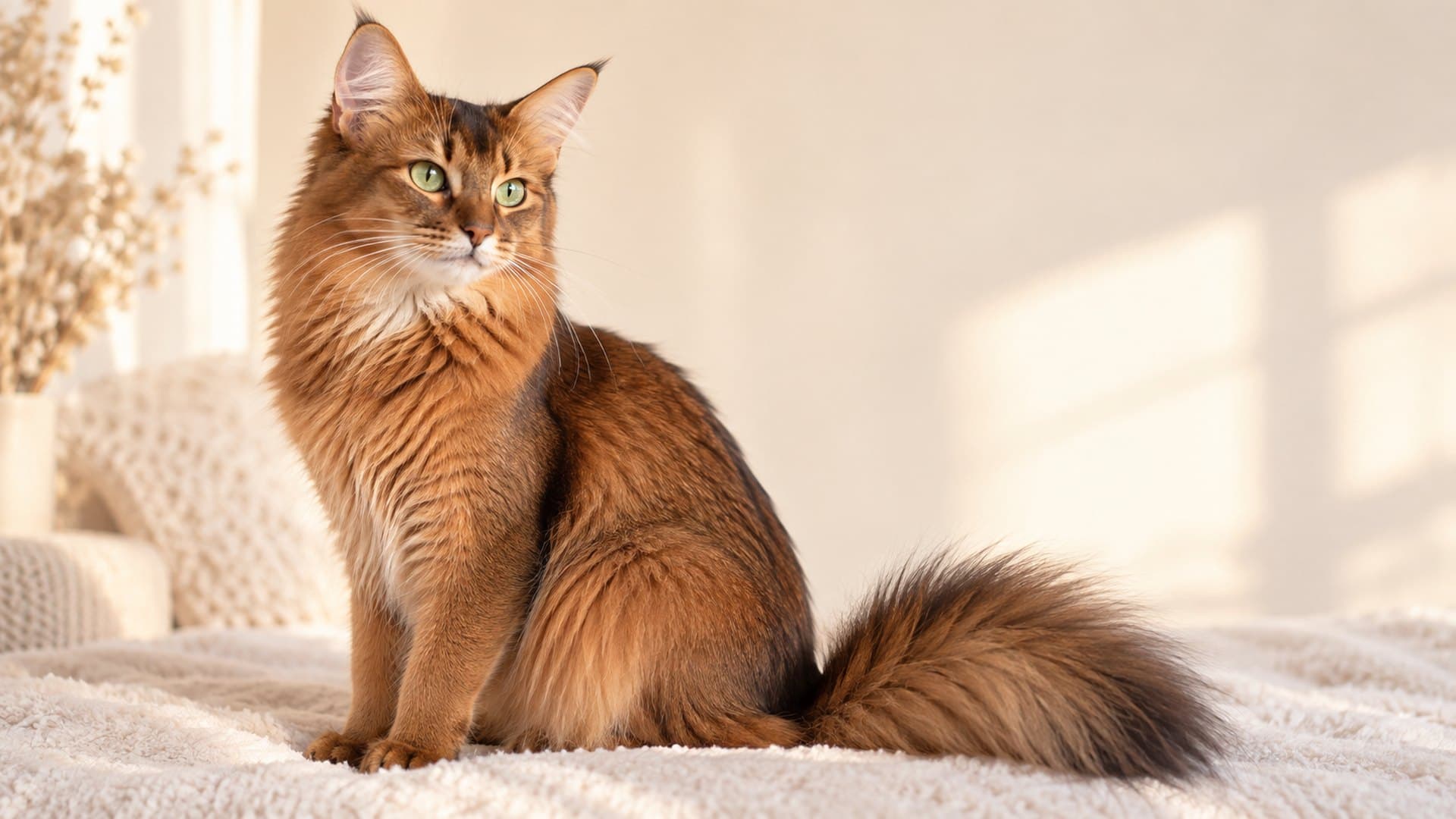

Myths about the Somali cat: what's true and what isn't
A “faulty Abyssinian”, a cat from Somalia, endless mats? We look at common claims about Somalis and explain what is actually true.
Published 4 min read

The Somali is not a very common breed, so people often talk about it second-hand. Some think it is just a fluffy Abyssinian, others dread a daily battle with mats, and others expect it to be as placid as a Persian. Here are the most common myths and what is actually known about each one, so that you can choose a kitten with the right expectations.
“A Somali is a faulty Abyssinian”
People really did think so once: in the first decades after the war, longhaired kittens from Abyssinian litters were considered undesirable and quietly placed as pets. But from the 1960s, breeders in the USA and Canada began breeding these cats deliberately. The Cat Fanciers' Association (CFA) granted the Somali championship status in 1979, and the UK's Governing Council of the Cat Fancy (GCCF) followed in 1998. Today it is a recognised breed in its own right with its own standard, and the long coat is not a flaw but its defining feature. In personality and build, Somalis and Abyssinians are almost identical, so the long coat can hardly be called a fault.
“The breed comes from Somalia”
The name is just wordplay. Evelyn Mague, the American breeder who stood at the breed's beginnings, named it after Somalia because the country borders Ethiopia, formerly Abyssinia. The Somali itself was developed in North America from Abyssinian lines, and according to the CFA the long-hair gene entered the Abyssinian breed back in the mid-20th century. The breed has no connection with the Horn of Africa: like the Abyssinian, it simply carries an “African” name. So a Somali needs ordinary home conditions, nothing “exotic”.
“A long coat means a daily battle with mats”
The Somali's coat is semi-long, very fine and soft, and it mats far less readily than, say, a Persian's coat. The CFA notes that weekly combing is enough for most Somalis to remove dead hair. The ruff, the breeches and the areas behind the ears and under the front legs need a little more attention, as does the moulting season. There is no need to bath a Somali unless there is a specific reason.
That said, International Cat Care generally recommends frequent grooming for longhaired cats, so be guided by the state of your own cat's coat: once a week is enough for some, while others need short daily sessions during a moult.
“Fluffy means calm and sofa-loving”
That luxurious coat is often misleading. In temperament, a Somali is a true Abyssinian: active, curious and with an agenda for every day. The GCCF says outright that their high energy means they are not usually lap cats. Somalis need daily play, vertical space and puzzles for the mind. If you are looking for a quiet companion that dozes most of the day, it is better to consider another breed. Somalis only calm down with age, and even then many stay playful as adults.
“A dark kitten has the wrong colour”
Somali kittens are often born dark, almost solid-coloured, and future owners sometimes worry that the colour is “wrong”. This is normal: the CFA specifically stresses that Somalis are extremely slow to show mature ticking. The colour lightens and gains depth gradually, and the full coat, ruff and tail only develop by 18 months to two years. So a photo of a three-month-old kitten is too early to judge by. The best person to ask about how the colour will develop is the breeder, who has seen kittens from the same parents grow up.
“Two Somalis can have a shorthaired kitten”
They cannot. Long hair in cats is a recessive trait controlled by a gene called FGF5: a cat is longhaired only if it has inherited the relevant copy from both parents. So all kittens from two Somalis will be longhaired. Shorthaired kittens appear when one parent is an Abyssinian: these kittens look like Abyssinians but carry the long-hair gene and can pass it on.
“Longhaired cats are less allergenic”
If anything, the opposite. There is no such thing as a hypoallergenic cat: the main cat allergen, a protein called Fel d 1, is produced by all cats in their skin glands and saliva and spreads onto the coat when they groom. International Cat Care notes that many people seem to react more strongly to longhaired cats, possibly because more allergen builds up on their fur. If someone in the family has an allergy, talk to a doctor first and spend time with adult cats of the breed.
Want to find out more? Read the breed page, browse the kittens of this breed or join the waiting list if there are no kittens right now.