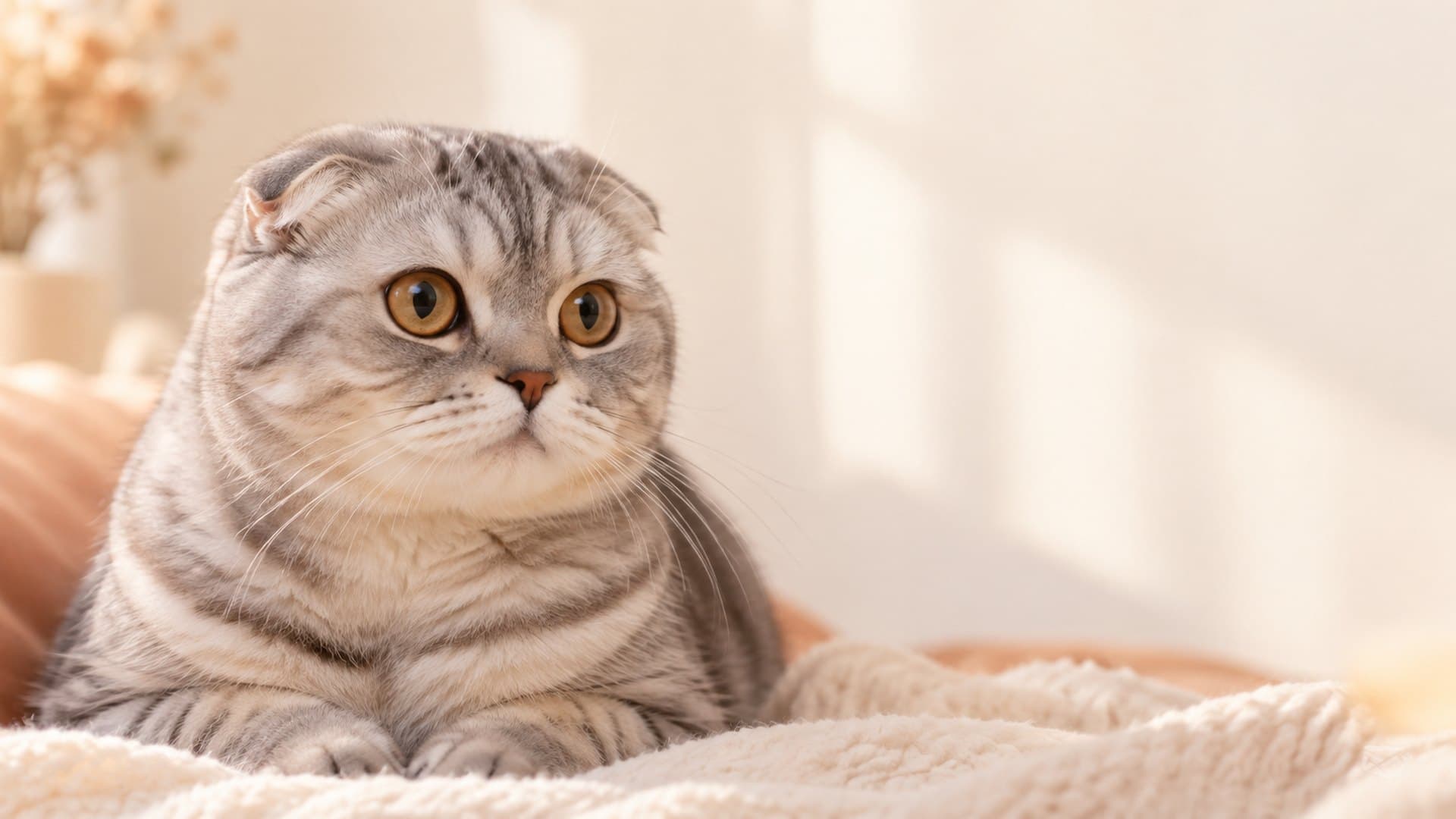

Scottish cat health: joints, DNA tests and what to ask a breeder
What to watch for in Scottish Folds and Straights: signs of joint trouble, DNA tests, heart screening and the questions to ask a breeder.
Published 4 min read

Scottish cats can be wonderful, affectionate companions for many years. But an honest conversation about this breed's health has to include the joints: the gene that folds the ears also affects cartilage throughout the body. On top of that, because they share ancestors with British Shorthairs and Persians, Scottish cats need some of the same health checks. Here's what to look out for. One note up front: diagnosis and treatment are always a job for a vet, and this article is only here to help you find your bearings.
The main issue: joints
In folded-ear cats, the same TRPV4 gene variant that folds the ear cartilage also disrupts the development of cartilage and bone. This condition is called osteochondrodysplasia. It can show up as shortened, misshapen bones in the legs and paws, a thick, stiff tail and early, painful arthritis. Severity varies widely: some cats show almost no signs for years, while others develop them at a young age. In an Australian study of veterinary records, clinically confirmed cases were most often diagnosed before the age of about two and a half, so the first years of life are an especially important time to keep watch. Read more about the genetics in our article “Why Scottish cats have folded ears”.
Scottish Straights usually don't carry this variant, and so don't have the changes linked to it. But any cat can develop arthritis with age, so mobility is worth watching in every cat.
Signs to watch for
Cats are experts at hiding pain, so the signals are often subtle. International Cat Care advises looking out for changes like these:
- the cat is reluctant to move or jump and picks lower spots;
- its gait has changed, or it limps or seems stiff, especially after sleeping;
- the tail has become stiff, or the cat won't let you touch it;
- the cat grooms less and its coat looks unkempt;
- the cat goes outside the litter tray, hides or eats less.
Any of these signs is a reason to book a vet appointment rather than waiting for it to pass. Compare your cat's behaviour with how it was a few months ago: gradual changes are easy to miss when you see your cat every day.
Diagnosis and the vet's role
Diagnosis is based on an examination and X-rays, which show the state of the bones and joints. Osteochondrodysplasia can't be cured, but a vet can help manage pain and support the cat's quality of life. Only a vet should decide on treatment. Regular check-ups, at least once a year and more often for older cats, help spot changes earlier.
Never give your cat painkillers from your own medicine cabinet: many human medicines are toxic to cats, even in small amounts. Any medication should only be given on your vet's prescription.
A joint-friendly home
Simple changes at home make life easier for a Fold, especially one already showing signs of joint trouble:
- steps or gentle ramps up to the sofa, bed and windowsill;
- soft, low-sided beds in warm spots;
- a litter tray with a low entrance;
- bowls the cat can reach comfortably without bending;
- a stable weight, since every extra pound puts more strain on the joints.
Other checks: kidneys and heart
Scottish pedigrees include British Shorthairs, and through them Persian ancestors. So, as with British Shorthairs, a DNA test for polycystic kidney disease (PKD1) is recommended for Scottish cats. The gene is dominant, and if both parents test negative, the kitten is not at risk of this form of the disease.
Because of their close relationship to British Shorthairs, which have a documented predisposition to hypertrophic cardiomyopathy, it's worth asking about the heart too. There's no DNA test for this disease in these breeds, so breeding cats are screened by echocardiography with a veterinary cardiologist.
What to ask the breeder
A responsible breeder will be happy to answer questions and show you the paperwork:
- do they only mate Folds with Straights? One of the kitten's parents must be straight-eared;
- does the straight-eared parent have a DNA test confirming it doesn't carry the fold gene;
- how old are the parents and how do they move? Can you see them, and are their tails flexible;
- what are both parents' PKD1 DNA results, and have their hearts been screened;
- which vaccinations, parasite treatments and vet checks has the kitten already had;
- is there a contract and support after the move?
If a breeder avoids questions about joints or offers a kitten from two folded-ear parents, keep looking.
You'll find more about the breed on the breed page. You can check the site to see whether any kittens of this breed are available right now, and if not, join the waiting list.