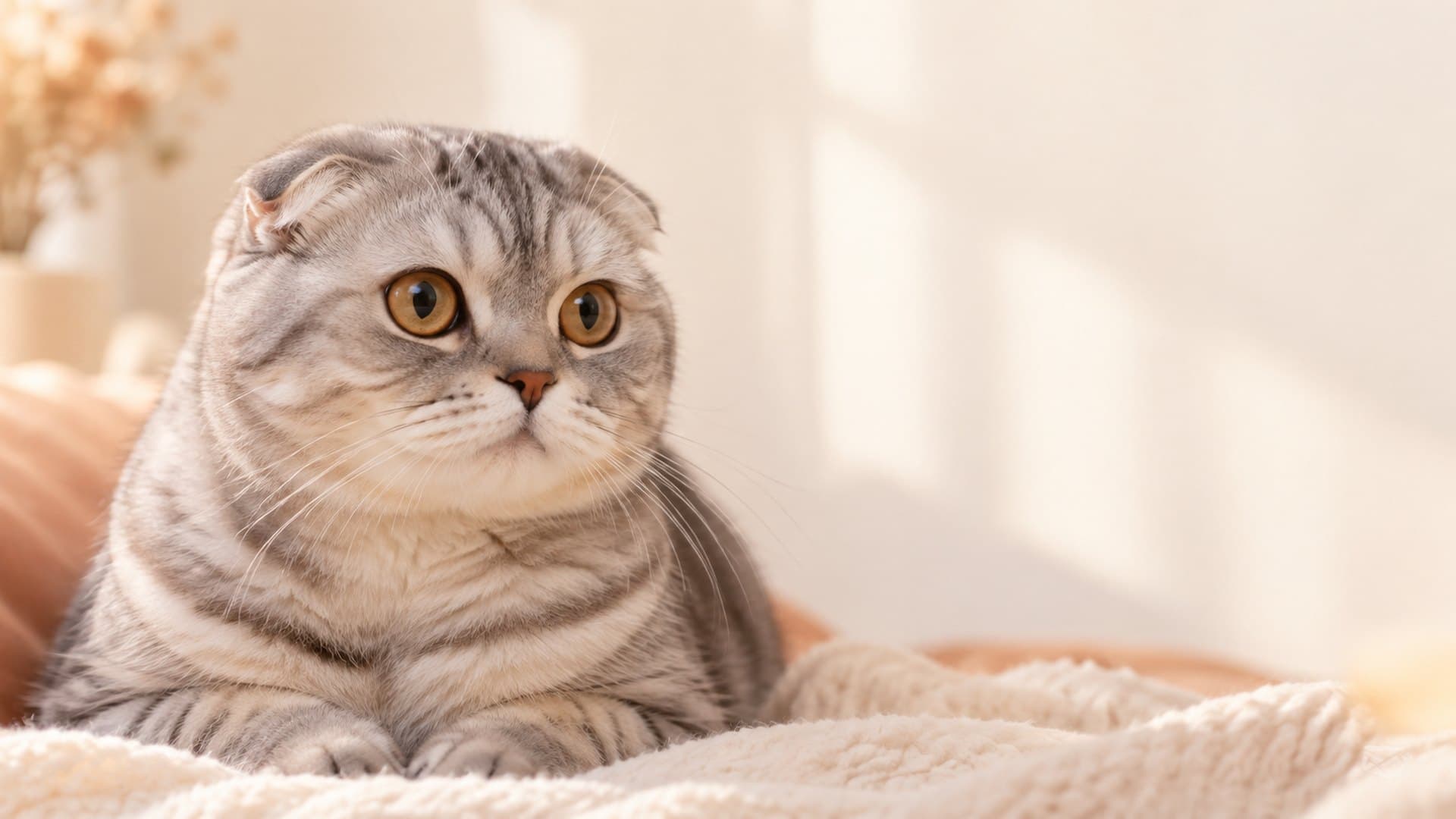

Scottish cat myths: folded ears, health and personality
Does the ear fold cause harm, are Straights “rejects”, and do Folds really hear poorly? We look at common myths about Scottish cats.
Published 3 min read

Scottish cats are one of the most popular breeds online, which is exactly why there are so many half-truths about them. Some myths lead people to underestimate the health risks; others unfairly write off straight-eared kittens. Here's what's actually true, based on information from veterinary and cat fancy organisations. Each point is a popular claim followed by what's actually known about it.
“Folded ears are just a cute look”
Sadly, no. The ear fold is caused by a variant of the TRPV4 gene, which affects cartilage not only in the ears but throughout the body. As a result, folded-ear cats can develop osteochondrodysplasia: misshapen bones in the legs and paws, a stiff tail and early, painful arthritis. How severely it shows varies a great deal, but according to UFAW, all folded-ear cats develop the condition to some extent. Folded ears aren't just a look; they come with responsibility. That's why the UK's GCCF and the international federation FIFe don't register folded-ear cats.
“Problems only happen when two Folds are mated”
Mating a Fold with a Fold really is the most dangerous combination: kittens with two copies of the gene suffer serious skeletal damage, so this pairing is considered unethical. But a single copy doesn't guarantee healthy joints either. Cats from a proper Fold-to-Straight mating may do well for years, or may develop painful changes early on. Studies give different estimates of how often the disease is diagnosed clinically, but the mechanism is the same in every Fold. So even with responsible breeding, a Fold's mobility needs watching closely throughout its life.
“A straight-eared Scottish cat is a reject”
Scottish Straights are a full part of the breed. About half the kittens from a Fold-to-Straight mating have straight ears, and that's a normal, expected result. Responsible breeders also DNA-test their Straights to make sure the variant really isn't there. Straights have the same gentle, calm personality, and they usually don't carry the fold gene or the cartilage problems linked to it. Responsible Scottish breeding is impossible without Straights, so calling them rejects is simply unfair. For many families, a straight-eared kitten is the wisest choice.
“Folded-ear cats have poor hearing”
There's no evidence that the fold of the ear itself harms hearing. The myth probably grew out of early worries among British cat fanciers, who in the early 1970s were concerned about the new breed's ears. What's worth knowing instead is that congenital deafness is more common in white cats, especially blue-eyed ones, regardless of breed, and Susie, the breed's founder, happened to be white. So a white kitten of any breed is worth having its hearing checked by a vet.
“The Buddha pose is just a funny habit”
Photos of Scottish cats sitting bolt upright with their hind legs stretched out in front collect thousands of likes. Healthy cats can indeed sit like that simply because it's comfortable. But in folded-ear cats, an unusual posture sometimes means it's uncomfortable to bend or put weight on the hind legs. If your cat sits like this more and more often, becomes reluctant to jump, moves stiffly or grooms less, take it to the vet. Only a vet can make a diagnosis, based on an examination and, if needed, X-rays.
“A Fold's ears need no special care”
The folded ear flap partly covers the entrance to the ear, so a build-up of wax or dirt is harder to spot. Once a week, gently check the ears without forcing the folds open. You can wipe the visible part with a damp cotton pad, but never put cotton buds into the ear canal. Dark discharge, a bad smell, scratching or head shaking are all reasons to see a vet. Only use ear cleaners if your vet recommends them.
“Scottish cats are independent and fine alone for long periods”
Their calm nature is often misleading. In fact, Scottish cats are very people-oriented and don't cope well with long stretches of loneliness. Most will get through a working day happily enough, especially with toys and scratching posts, but regular long absences are a real ordeal for this breed. If you travel a lot, think about who could keep your cat company (a second cat with a similar temperament often works well, as long as they're introduced gradually), or consider a more independent breed.
Find out more about the breed in our articles “Scottish cat personality” and “Scottish cat health”, and on the breed page. You can check the site to see whether any kittens of this breed are available right now, and if not, join the waiting list.