

Why Scottish cats have folded ears, and what the fold gene means
The story of Susie the cat, fold genetics in plain words, the honest truth about cartilage and joints, and why responsible breeders pair a Fold only with a Straight.
Published 4 min read
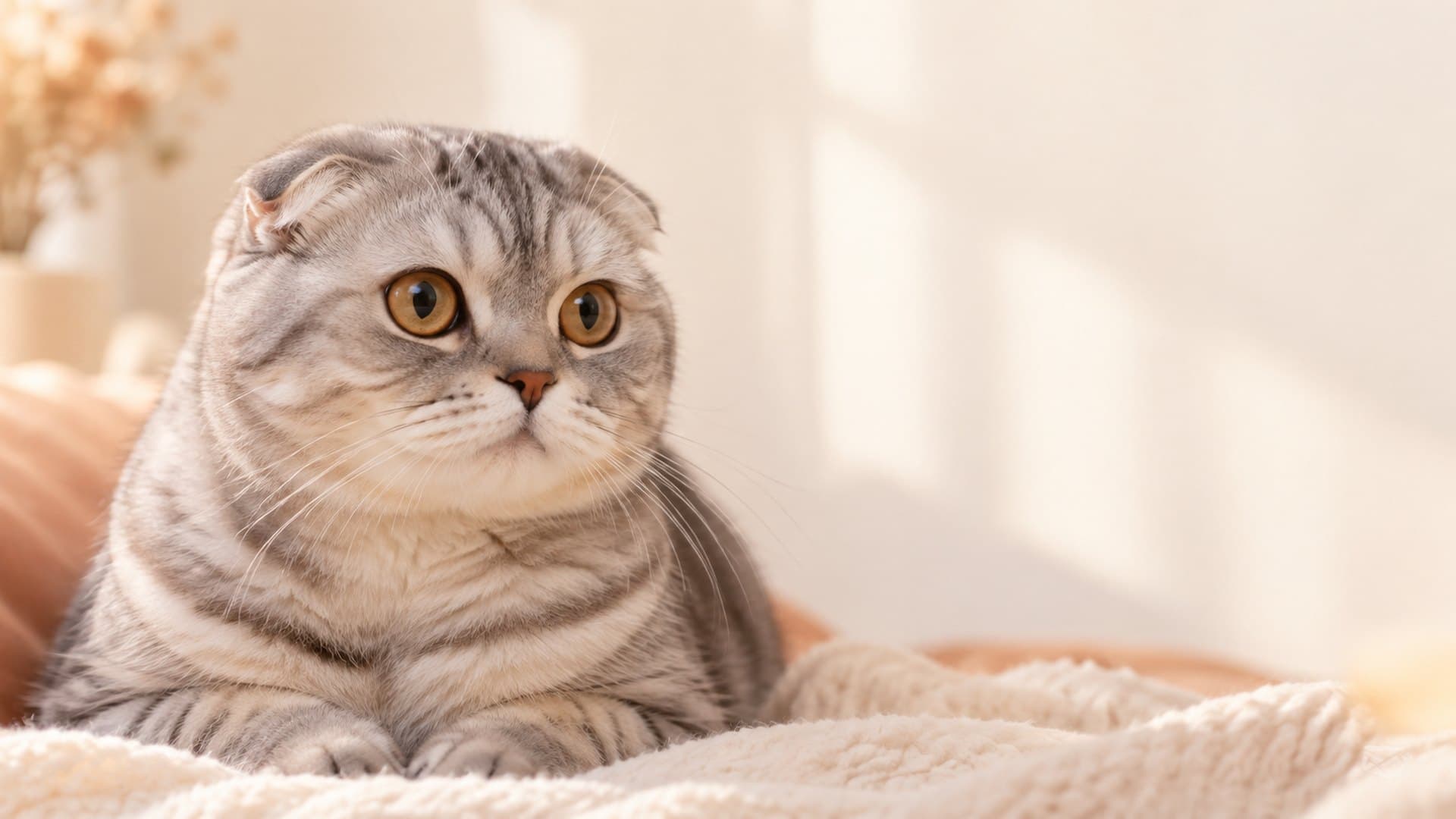
Small ears pressed flat against a round head make Scottish Folds look like owlets or soft toys. That one feature made the breed famous around the world. But behind the sweet look is a genetic trait that anyone considering a Scottish kitten deserves to hear about honestly. Here's where the folded ears came from, how the fold gene works and what vets and cat associations say about it.
Susie and the start of the breed
The breed's story began in 1961 on a farm near the town of Coupar Angus in Scotland. A white cat named Susie lived there, with unusual ears that folded forwards and down. She caught the eye of a neighbouring farmer and cat lover, William Ross. When Susie had kittens, two of them also had folded ears, and Ross and his wife took one of them, a female called Snooks. Snooks became the foundation queen of the breed.
At first Scottish cats were registered with the UK's Governing Council of the Cat Fancy (GCCF), but by the early 1970s registration had stopped over concerns about the cats' ears and health. The breed was developed further mainly in the USA: the CFA granted championship status to shorthaired Scottish Folds in 1978 and to longhairs in 1992. To widen the gene pool, Scottish cats were crossed with British and American Shorthairs, which is why there are so many British Shorthairs in their pedigrees.
How the fold gene works
The folded ears came from a spontaneous mutation; nobody set out to create them. In 2016, researchers found that the fold is caused by a change in the TRPV4 gene, which plays a role in cartilage development.
This gene variant is dominant. Put simply, a kitten only needs to inherit it from one parent for its ears to fold. Kittens are born with straight ears, and the fold appears at around three to four weeks. The degree of fold varies, from barely noticeable to tightly flattened against the head.
Not just the ears
The fold gene doesn't only affect ear cartilage; it affects cartilage and bone throughout the body. Abnormal development of cartilage and bone is called osteochondrodysplasia. In Scottish Folds, it can show up as shortened, misshapen bones in the legs and paws, a thick, stiff tail and early arthritis, meaning painful changes in the joints.
According to the UK science and welfare charity UFAW, all folded-ear cats develop this condition to some extent, and International Cat Care explains that the same genetic defect that folds the ear cartilage also disrupts cartilage development in the bones. How severely it shows is highly individual. Some cats show almost nothing for years, while others develop painful changes at a young age. There's no way to predict it in advance.
The disease is most severe in cats that inherit the fold gene from both parents. That's why mating a Fold with a Fold is considered unethical: some of the kittens receive two copies of the gene and almost inevitably suffer serious skeletal damage.
Folds and Straights
Responsible breeders only pair a Fold with a straight-eared cat. In such a mating, roughly half the kittens are born Folds and half Straights. Scottish Straights usually don't carry the fold variant, and so don't have the problems linked to it. There are exceptions, though, which is why the CFA stresses the importance of DNA testing before every mating.
Straights aren't “rejects”. They're a full part of the breed, with the same gentle personality, and responsible Scottish breeding would be impossible without them.
What standards and laws say
Cat associations don't all agree. The American CFA and TICA recognise the Scottish Fold, and the CFA standard states plainly that a well-bred Fold should have a flexible tail and move normally. Meanwhile, the UK's GCCF and the international federation FIFe don't register folded-ear cats. International Cat Care considers it unethical to breed cats with a mutation known to cause painful disease.
Some countries have put this into law. In the Netherlands, since 1 January 2026 it has been illegal to breed, sell or acquire new folded-ear cats; those born earlier and microchipped can live out their lives with their owners.
What it means for you
If you've fallen for Scottish cats, an honest approach looks like this:
- choose a breeder who only pairs a Fold with a Straight and shows you DNA test results;
- consider a straight-eared kitten: the personality is the same, and without the fold gene there's no fold-related osteochondrodysplasia;
- if you choose a Fold, keep an eye on its mobility throughout its life and take it for regular vet checks.
For the signs to watch for and the questions to ask a breeder, read our article “Scottish cat health”.
You'll find more about the breed on the breed page. You can check the site to see whether any kittens of this breed are available right now, and if not, join the waiting list.


