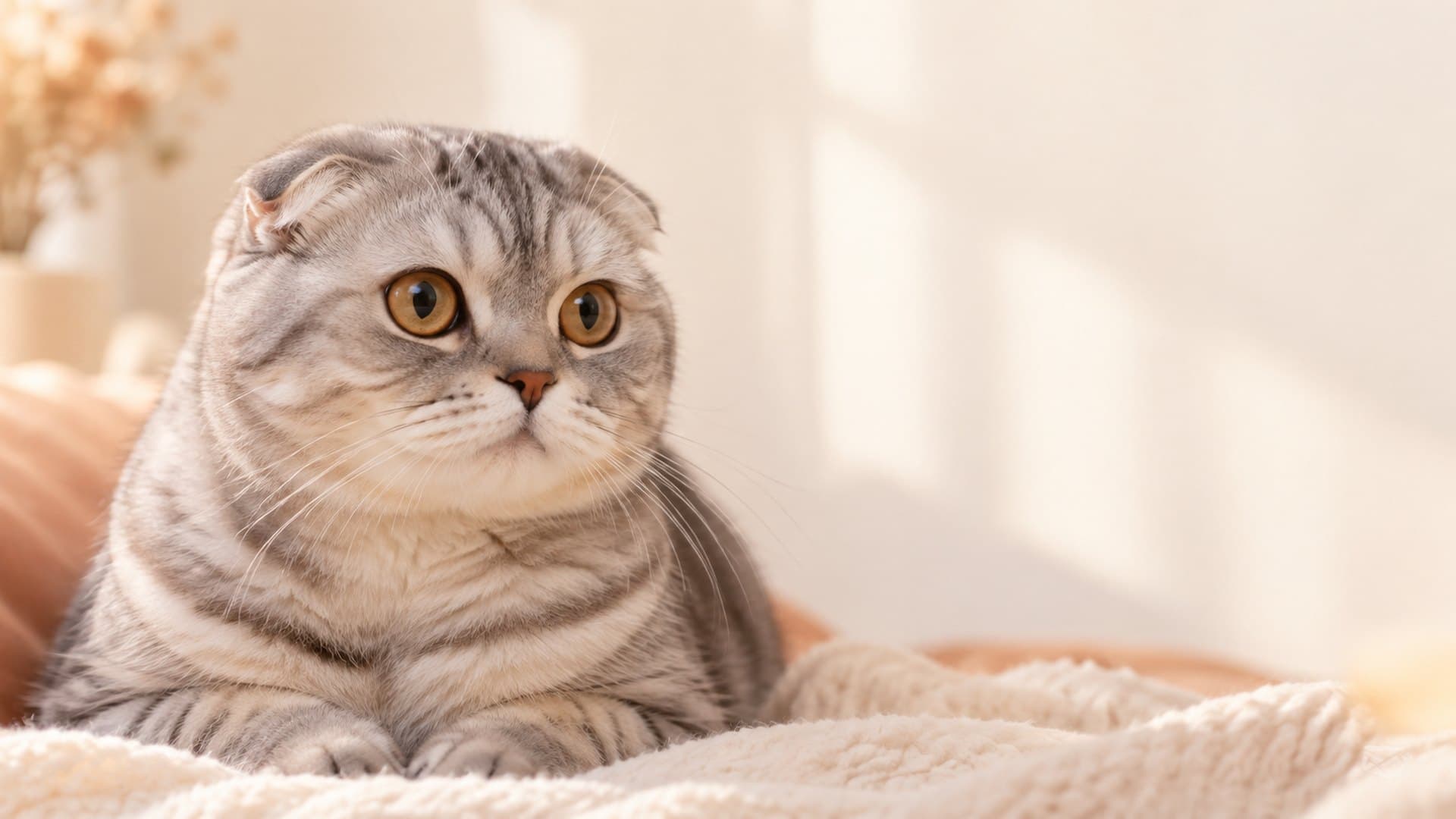

Scottish cat personality: life with a Fold or a Straight
Gentle, calm and very attached to their people: here's what Scottish cats are like at home, how much attention they need and who they suit.
Published 4 min read

Scottish cats come with folded ears (Folds) or straight ears (Straights), in short and long coats. But in personality they're all very much alike: ear shape has no effect on temperament. Scottish cats are usually described as gentle, calm and very people-oriented. As always, this is a typical portrait of the breed, not a guarantee. Every kitten has its own nature, so before you choose, take a close look at the individual.
Gentle homebodies
Scottish cats love home, comfort and their people. They're happy to spend time close by: curling up on the sofa next to you, watching you cook dinner, lying on the desk beside your laptop. Unlike some independent breeds, a Scottish cat doesn't just tolerate your company; it seeks it out.
Most have soft, quiet voices and don't “talk” much. Demanding attention with loud meowing isn't their style. A Scottish cat is more likely to come over and sit quietly beside you, waiting for you to notice.
Many Scottish cats enjoy being stroked and picked up, although, like any cat, they need to be able to walk away when they've had enough. Some become especially attached to one person, while staying gentle and friendly with the rest of the family.
Company above all
That attachment to people has a flip side: Scottish cats don't do well when left alone for long periods. Most cope fine with an ordinary working day, especially if there's something to keep them busy. But regular long absences, business trips or an empty house from morning till night can leave a cat sad and anxious.
If you're often away, think about who could give the cat attention, or consider a second cat with a similar temperament to keep it company. And when you get home, set aside at least half an hour for play or quiet time together.
Play without acrobatics
Scottish cats are playful, but not overly boisterous. They like games that make them think: treat puzzles, feather wands, balls rolling across the floor. Many quickly figure out the rules, and some will even bring a toy back for you to throw again.
A typical Scottish cat's day is fairly relaxed: a morning game and breakfast, a long nap somewhere warm, an evening hunt for the feather wand and a quiet evening beside its people. A few short play sessions a day help the cat stay in good shape and avoid putting on weight.
Focus on games at floor level or on low surfaces, and put steps or a ramp up to favourite high spots. This is especially worthwhile for Folds: it's an everyday way of looking after their joints.
Children and other pets
Thanks to their mild, patient nature, Scottish cats usually get along well with children who know how to handle a cat gently. Teach kids not to grab the cat, not to lift it by the legs and not to pull its tail, which matters particularly for this breed. Playing with a wand toy is better than using hands.
Most Scottish cats also get on with other cats and friendly dogs, as long as introductions are gradual and supervised. A newcomer needs its own corner, separate bowls and litter tray, and time to settle in.
Funny poses: cute, but watch closely
Scottish cats are famous for their funny poses. They like to sit bolt upright with their hind legs stretched out in front, like a little person, or sleep on their backs with their paws in the air. It's one reason their photos are so popular online.
With Folds, though, it's worth watching for any change. If your cat starts sitting differently from before, becomes reluctant to jump, moves stiffly or avoids having its legs and tail touched, that's not a personality quirk but a reason to see the vet. Read more in our article “Why Scottish cats have folded ears”.
Who a Scottish cat suits
A Scottish cat is a good match for:
- families where someone is often at home;
- people who want a gentle, calm companion;
- homes with children who know how to treat animals kindly;
- anyone who values a quiet voice and undemanding affection.
You may want to consider another breed if you're rarely at home or you're looking for an independent cat that's happy as long as the bowl is full. Before choosing, talk to the breeder about the individual kitten's personality: how it behaves with people, how bold it is, whether it likes to play.
You'll find more about the breed on the breed page. You can check the site to see whether any kittens of this breed are available right now, and if not, join the waiting list.