

Why the Abyssinian coat shimmers: the ticked coat and its story
Where the Abyssinian came from, how the ticking gene works and what breed standards say about colour, eyes and build, in plain words.
Published 4 min read
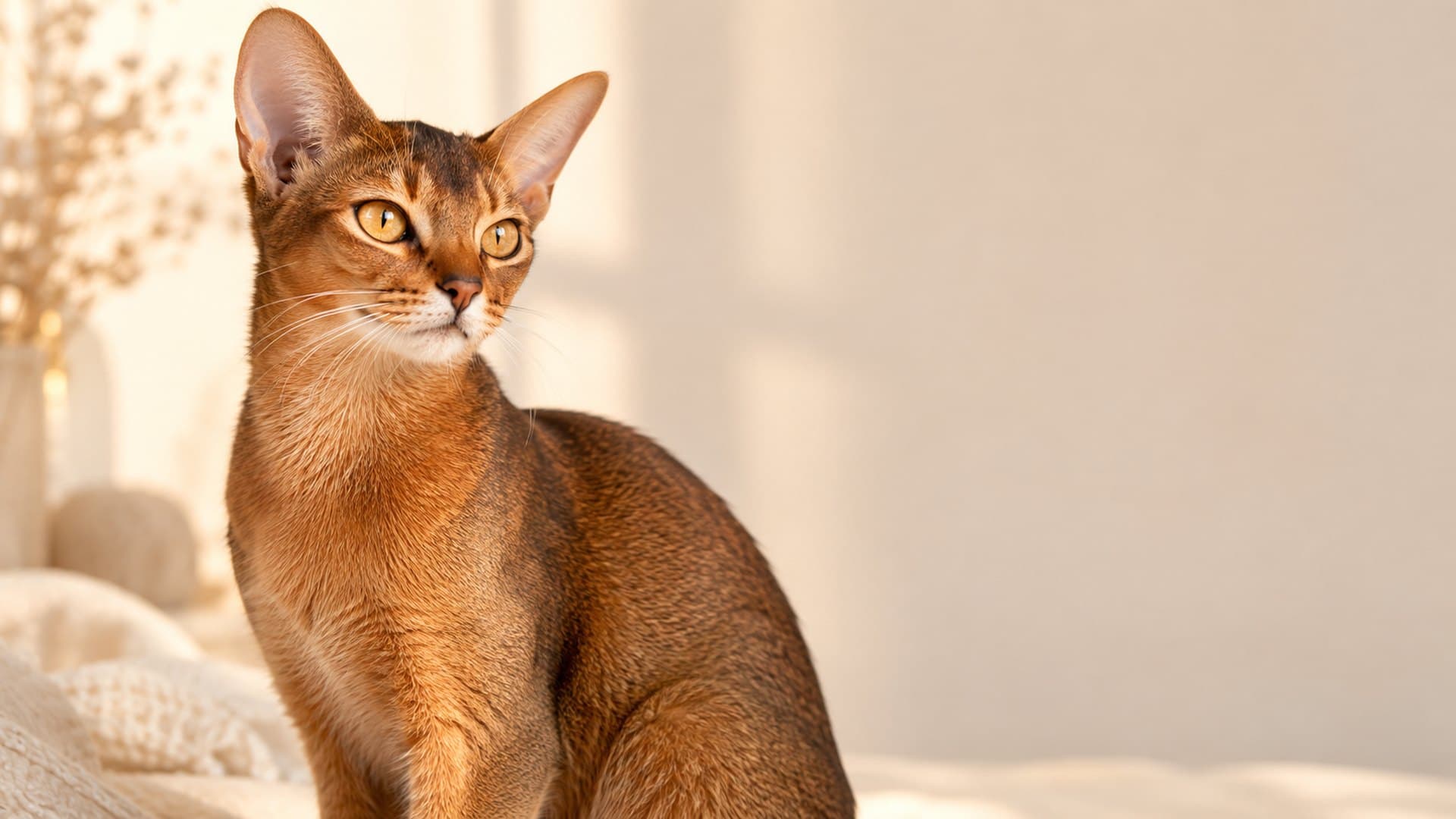
Look at an Abyssinian in a patch of sunlight and its coat seems to glow from within. That effect comes from the ticked coat: every single hair is coloured with several bands. Ticking is what makes the breed recognisable at a glance, and it is the thing future owners ask about most often. Here is where Abyssinians came from, how their coat works and what the breed standards say about it.
Where the breed came from
The name refers to Abyssinia, the old name for Ethiopia. According to a popular story, the breed's founder was a cat called Zula, brought to England in 1868 after the British military expedition to Abyssinia. The Cat Fanciers' Association (CFA) notes that an Abyssinian was already being shown at London's Crystal Palace in 1871. Whether today's Abyssinians really descend from Zula is unknown: nobody kept pedigrees back then.
Genetic research cited by the CFA suggests that the breed's ancestors most likely came from the coast of the Indian Ocean and Southeast Asia rather than from Ethiopia itself. British breeders gave the Abyssinian its modern look, and the UK's Governing Council of the Cat Fancy (GCCF) officially recognised the breed in 1929. Abyssinians reached the United States in the early 20th century and were among the first breeds the CFA registered, back in 1906.
What ticking is
An ordinary tabby has a pattern on its body: stripes, spots or marbled swirls. An Abyssinian has almost no pattern on its body. Instead, each hair carries several alternating dark and light bands, with a dark tip. When millions of these hairs lie together, you get an even, warm, almost shimmering colour that changes with the light. The GCCF standard asks for distinct ticking with at least four bands of colour on each hair.
Some pattern does remain on the head: dark “eyeliner” around the eyes, pale areas next to them and the classic “M” on the forehead. A darker line often runs along the spine to the tip of the tail too.
The genetics in plain words
Ticking is a type of tabby pattern, not a separate “wild” trait. In 2021, American geneticists (Kaelin and colleagues, in Nature Communications) showed that changes in a gene called DKK4 are responsible for the ticked pattern. Even in the embryo, this gene influences how future dark and light areas are laid out on the skin. When it does not work in the usual way, the dark areas become tiny and densely packed, and instead of stripes we see even ticking.
The ticking gene is dominant over the other tabby patterns: a kitten that inherits it from one parent will already be ticked, although traces of stripes may show on the legs, tail or neck. Breeding programmes aim to eliminate those traces.
Kittens with “ghost” stripes
Abyssinian kittens are often born darker than they will be as adults, and faint stripes may be visible on their legs and tail. This is normal: the colour lightens with age, the ticking opens up and the ghost stripes usually fade. The final coat generally develops over the first year to eighteen months, so a photo of a three-month-old kitten does not yet show what the adult cat will look like.
What the standards say
Standards differ in the details from one association to another, but the overall picture is similar:
- body: medium-sized, lithe and muscular, on slender legs; the CFA says an Abyssinian looks as if it is standing on tiptoe;
- head: a gently rounded wedge without sharp lines, with large, alert ears, sometimes tipped with lynx-like tufts;
- eyes: large and almond-shaped, gold or green, rimmed with a dark line;
- colours: the classic ruddy (a warm reddish brown, called “usual” in the UK), sorrel or red, blue and fawn. Some associations, including the GCCF, also accept silver varieties and additional colours.
For a pet, small deviations from the standard make no difference at all, but for shows and breeding programmes they do matter.
What it means for an owner
The short ticked coat lies close to the body, hardly ever mats and needs no complicated grooming. Colour has no effect on personality: a ruddy and a blue Abyssinian are equally energetic. A kitten's background, on the other hand, does matter: the breed has some inherited conditions, and DNA tests exist for several of them. We cover these in a separate article on Abyssinian health.
Want to see ticking in real life? Visit the breed page and the kittens of this breed section; if there are no kittens right now, join the waiting list.


