
Myths about the Abyssinian cat: what's true and what isn't
A pharaoh's cat, a mini puma, a hypoallergenic breed? We look at popular claims about Abyssinians and explain what is actually true.
Published 4 min read

Plenty of lovely stories are told about Abyssinians, and some of them turn up even in kitten adverts. A few of these claims are simply romantic; others can nudge people towards the wrong choice. Here are the most common myths and what is actually known about each one. The clearer your picture of the breed, the easier it is to choose a kitten that will really fit into your life.
“Abyssinians descend from the sacred cats of Egypt”
The likeness between an Abyssinian and the cats in ancient Egyptian paintings is genuinely striking, and the legend has been around for more than a century. But there is no evidence of a direct link. The breed's name comes from Abyssinia (today's Ethiopia): according to tradition, the first known cat of this type was brought to England from there. Genetic research cited by the Cat Fanciers' Association (CFA) points instead to the coast of the Indian Ocean and Southeast Asia. And the breed's modern look was shaped by British breeders in the late 19th and early 20th centuries. So if an advert promises a “pharaoh's cat”, take it as a nice metaphor, not a pedigree.
“It's a semi-wild cat, a mini puma”
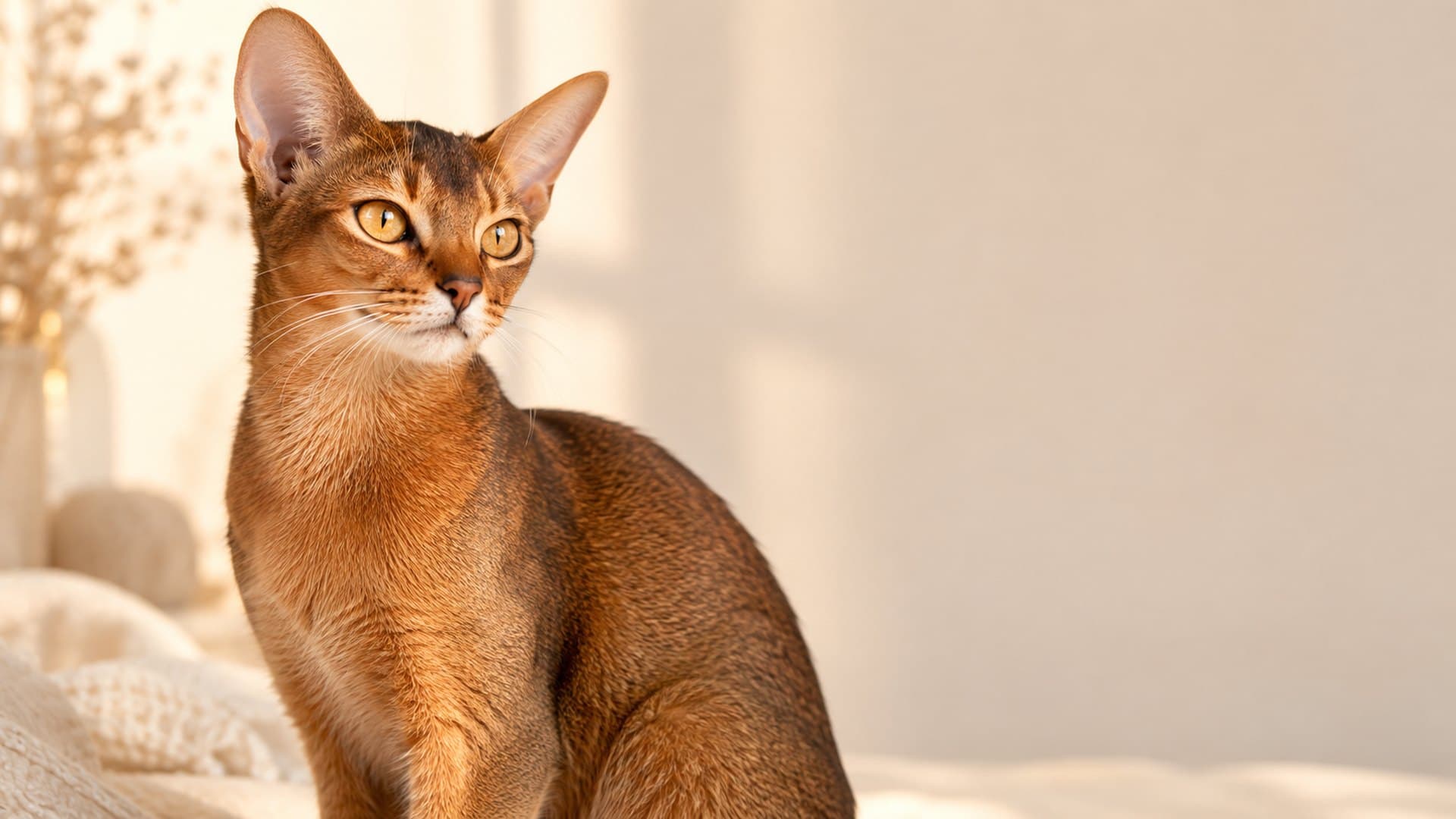
The Abyssinian is a fully domestic breed with no wild cat ancestry at all. Its “wild” look comes from the ticked coat, in which every hair carries several bands of colour. Geneticists have found that this pattern is controlled by a gene called DKK4, and the ticked pattern itself is simply a variety of the ordinary tabby, one that also occurs in non-pedigree cats. The large ears and lithe body are the result of selective breeding, not wild origins.
Nor should Abyssinians be confused with hybrid breeds such as the Bengal or the Savannah, which really do have wild cats in their pedigrees. The Abyssinian has no such ancestors, so it has no special “wild” needs beyond daily play and room to move.
“Abyssinians don't like people and won't be handled”
Abyssinians are usually very attached to their family: they follow their people around, join in with everything and meet them at the door. They simply show love in their own way, through presence rather than hours on your lap. Many Abyssinians dislike being held for long because they want to keep moving. A kitten that has been gently handled from an early age is usually relaxed about cuddles, check-ups and grooming, as long as they are brief and on its own terms. If what you really want is a lap cat, ask the breeder about the individual kitten: some Abyssinians are gentler and calmer than others.
“Short hair means the cat is hypoallergenic”
There is no such thing as a hypoallergenic cat. The main cat allergen, a protein called Fel d 1, is produced in skin glands and saliva and ends up on the coat when the cat grooms itself. So the reaction is caused not by hair length but by the protein, which all cats produce. An Abyssinian's short coat is just less noticeable on the furniture. Some people with mild allergies find certain cats easier to live with than others, but there is no way to predict this in advance. If someone in the family has an allergy, talk to an allergy doctor first and spend time with adult cats of the breed before taking a kitten home.
“Abyssinians are very loud”
This myth often comes from confusing them with Siamese and Oriental cats. Abyssinians actually have a quiet voice: the UK's Governing Council of the Cat Fancy (GCCF) describes them as vocally quiet cats that greet their owner with a short, melodic chirrup. Of course, every cat is an individual, and a bored kitten may insist loudly on attention. But constant “concerts” are not typical of the breed. And if a normally quiet cat suddenly starts yowling, take it to the vet: a change in behaviour can be a sign of discomfort.
“Abyssinians only come in ginger”
The best-known colour is ruddy: a warm reddish brown with dark ticking. But the standards also recognise other colours, such as sorrel (red), blue and fawn, and some associations accept silver varieties as well. Personality does not depend on colour: a blue Abyssinian is every bit as tireless as a ruddy one. What is more, kittens of every colour are born darker than they will be as adults, so the final shade takes time to show.
“The breed is healthy, so tests aren't needed”
Abyssinians are generally robust cats, but some inherited problems are known in the breed: pyruvate kinase deficiency (a form of anaemia), progressive retinal atrophy, renal amyloidosis and a tendency to gum problems. DNA tests exist for pyruvate kinase deficiency and for two forms of retinal atrophy, and responsible breeders test their breeding cats. You will find the details in our article on Abyssinian health. Discuss any questions about an individual cat's health with a vet.
Want to get to know the breed better? Read the breed page, browse the kittens of this breed or join the waiting list if there are no kittens right now.