

Why is the Selkirk Rex curly? The breed's story and its curl gene
From a curly kitten in Montana to a recognised breed: where the Selkirk Rex curls come from, how they are inherited and what the standard says.
Published 4 min read
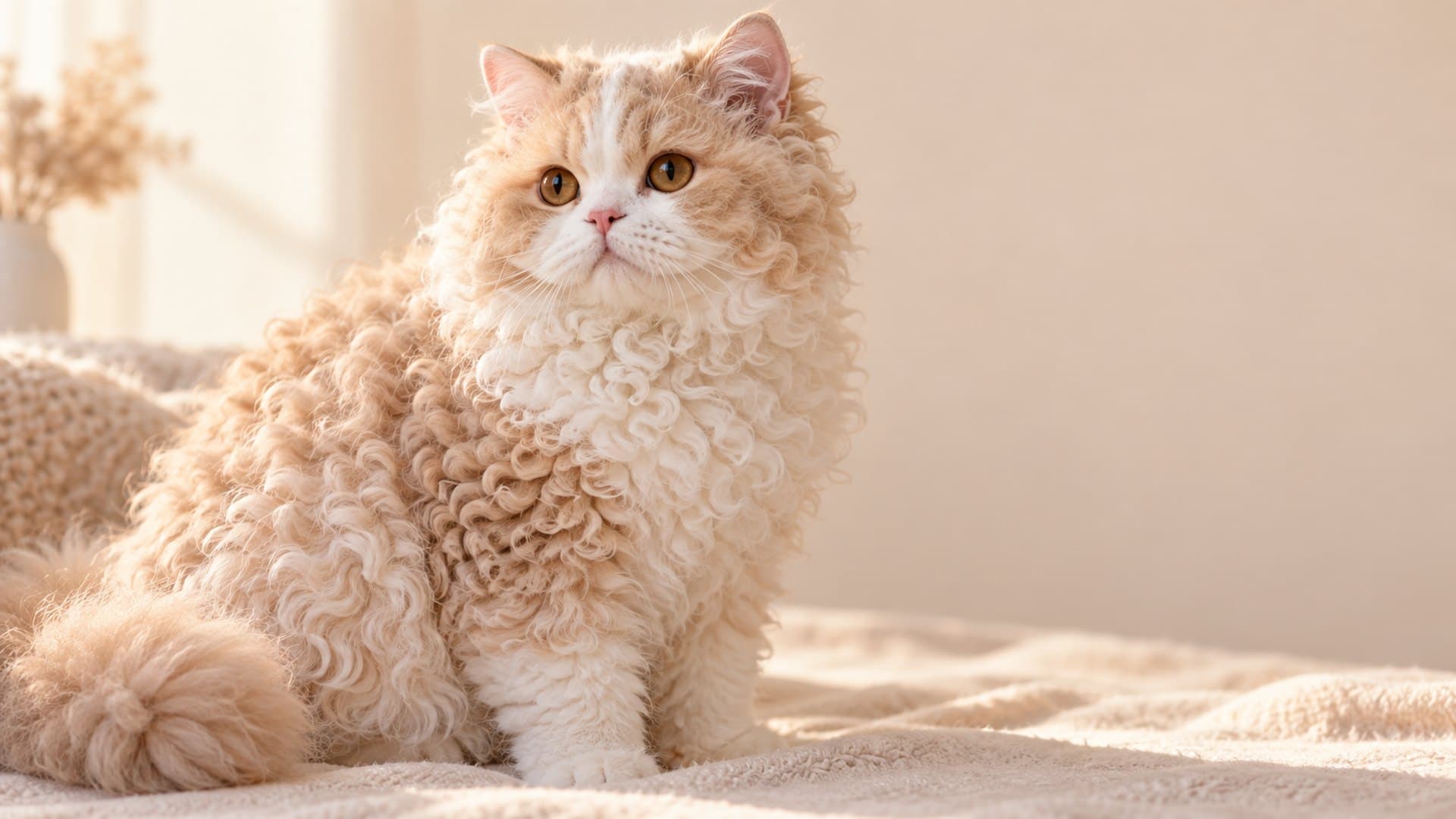
A Selkirk Rex looks as if it has just come out of curlers. Behind that teddy-bear look is an interesting story: one unusual kitten, an attentive breeder and a genetic quirk that sets the Selkirk apart from every other curly breed. Here is, in plain words, where the curls come from and what to expect from them.
A kitten called Miss DePesto
The breed's story began in 1987 in Montana, USA. An ordinary cat taken in by a shelter gave birth to six kittens, and only one of them had a curly coat and curly whiskers. The kitten was named Miss DePesto and went to Jeri Newman, a Persian breeder with an interest in genetics.
When Miss DePesto grew up, she was mated with a black Persian male. Three of the six kittens in the litter were curly. For a geneticist this was an important clue: a trait that shows up in the very first generation after a cross with a straight-coated cat is most likely dominant. The breed was named after the family of the breeder's stepfather, Selkirk. According to the CFA, it is the only cat breed named after a person.
A dominant gene: what it means in practice
Devon Rex and Cornish Rex cats are curly too, but in them the trait is recessive: a kitten is curly only if it inherits the “curly” version of the gene from both parents. The Selkirk is different: one copy is enough. In practice, if a curly Selkirk with one copy of the gene is mated with a straight-coated cat, roughly half the kittens will be curly and half will not.
In 2013 geneticists found the cause: a change in the KRT71 gene, which codes for one of the keratins in the hair. Interestingly, the Devon Rex has a change in the same gene, but in a different place and acting recessively, while the Cornish Rex curl is linked to a completely different gene.
The Selkirk gene shows incomplete dominance:
- a cat with one copy has a wavy coat with distinct curls;
- a cat with two copies usually has tighter, denser curls;
- a cat with no copies is straight-coated, even if both parents are curly.
That is why straight-coated kittens often turn up in Selkirk litters. They are just as much part of the breed in ancestry and temperament, simply without the curls.
The curls grow with the cat
Selkirk Rex kittens are usually born curly. But during adolescence the coat may straighten for a while or look less defined, and it only reaches its final form at around two years old. The UK's GCCF notes that the amount of curl varies with age, sex, season and hormones, especially in females. So if your kitten looks “less curly” at six months than in the photos taken at two months, that's normal.
It isn't only the coat that curls: Selkirks have curly whiskers and curly hair in their ears too, so their ears are worth checking regularly.
Short and long coats
Selkirk Rex cats come in shorthair and longhair varieties. The shorthair coat is dense and plush, with curls visible all over the body. In longhairs the curls are longer and look like luxurious ringlets, especially on the neck, the britches and the tail. Almost any colour is possible.
Coat length is inherited separately from the curl: long hair in cats is a recessive trait, so two shorthaired Selkirks can occasionally produce longhaired kittens.
What the standard says
Breed standards describe the Selkirk as a medium to large cat with a solid, muscular body and heavy bone. The head is round with full cheeks, the eyes are large and round, and the muzzle is short and rounded but not flat like a Persian's. According to the CFA, adult males weigh roughly 5.5–6.8 kg (12–15 lb), with females somewhat smaller.
To widen the gene pool of this young breed, Persian, Exotic and British Shorthair cats were used in breeding. The rules on such outcrosses are gradually tightening: in the CFA, for example, kittens born on or after 1 January 2025 must have only Selkirk Rex parents to be registered as Selkirks. This ancestry explains both the breed's calm temperament and why certain genetic tests matter for it, as we explain in “Selkirk Rex health”.
The takeaway
The Selkirk's curls come from a natural dominant mutation in the KRT71 gene that appeared in a single kitten in 1987. The curl is inherited more simply than in Devons and Cornish, but any litter may include straight-coated kittens, and the coat's final look only becomes clear closer to two years of age.
There's more about the breed on the breed page. Take a look at Selkirk Rex kittens, or if there are none right now, join the waiting list.


