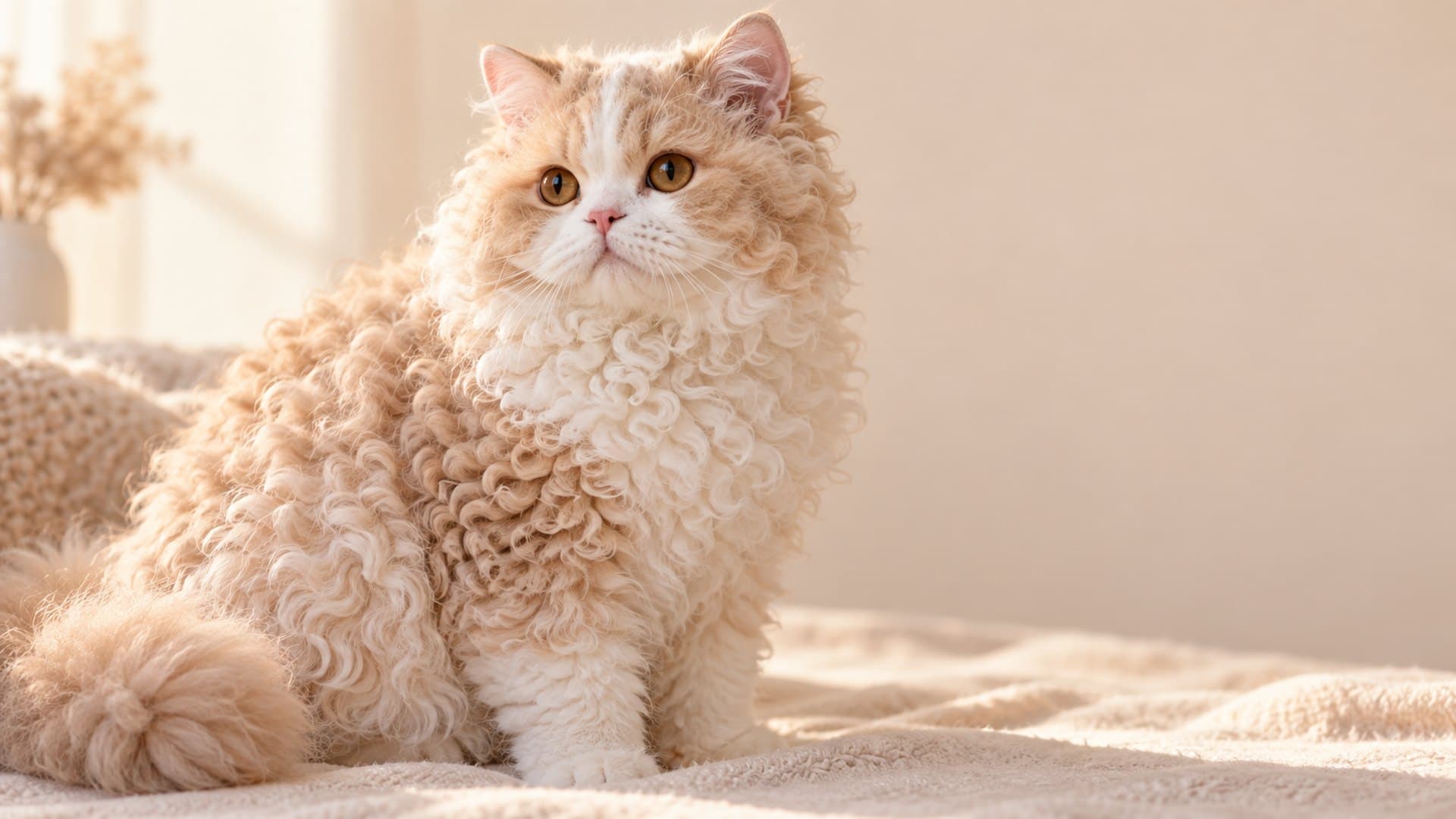

Selkirk Rex myths: what's true and what isn't
Do curly cats really not shed or cause allergies? We look at six common claims about the Selkirk Rex and explain what is actually true.
Published 4 min read

The Selkirk Rex is a young and fairly rare breed, so there's plenty of guesswork around it. Some people credit the curls with almost magical properties, others mix the Selkirk up with the Devon Rex or think of it as simply a “curly Persian”. Some of these ideas are harmless, while others can mislead a family choosing a kitten. We've gathered the most common claims and explain which of them hold up.
“Curly cats are hypoallergenic”
This is the most widespread and the riskiest myth. Cat allergy is usually caused not by the hair itself but by a protein called Fel d 1, produced by the sebaceous and salivary glands. The cat grooms, the protein ends up on the coat, and from there it gets onto furniture, clothes and into the air. Curls don't reduce the amount of this protein, and cats that cause no allergy at all simply don't exist: every cat produces Fel d 1, although levels vary from cat to cat. Entire (unneutered) males usually produce more of it than females and neutered males, but even they produce enough to trigger symptoms in sensitive people.
If someone in your family has allergies, talk to an allergy specialist and spend a few hours around adult cats before you decide. It's far better to find out how you react in advance than to have to look for a new home for the cat later.
“Selkirks don't shed”
They do, like every cat with a full coat. A Selkirk has both long guard hairs and a soft undercoat, so during the seasonal moult you will notice a lot more hair on furniture and clothes. Dead hairs that haven't fallen out easily get tangled in the curls and form mats, especially in longhaired cats. That's why regular combing isn't a whim but part of basic care. It also reduces the amount of hair the cat swallows while grooming.
“Curly parents only have curly kittens”
Not always. The Selkirk gene is dominant, but a cat with one copy passes it on to roughly half of its offspring. So many litters contain both curly and straight-coated kittens. The straight-coated ones are just as much Selkirks in ancestry and temperament, simply without the curls, and for a family looking for a gentle cat they are every bit as good a choice. Only a cat with two copies of the gene produces all-curly kittens.
“The curls you see in a kitten are the curls it will always have”
A Selkirk's coat changes with age. Kittens are usually born curly, the curls may straighten for a while during adolescence, and the coat reaches its final form at around two years. The amount of curl is also affected by season, hormones and sex: the UK's GCCF notes that these changes are particularly noticeable in females. So a photo of a two-month-old kitten can't tell you exactly what the adult cat will look like. If a strong curl really matters to you, ask the breeder what the parents' coats look like and how kittens from earlier litters turned out as adults.
“A Selkirk is just a curly Persian, or a relative of the Devon Rex”
Neither. Persian, Exotic and British Shorthair cats did help to widen the young breed's gene pool, and their sturdiness shows in the Selkirk's build. But this is a separate breed with its own standard and its own curl gene. The rules on outcrossing are gradually tightening: in the CFA, kittens born from 2025 onwards must have only Selkirk Rex parents.
What the Selkirk shares with Devon and Cornish Rexes is really just the curls. Their curl is recessive and caused by different genetic changes, while the Selkirk's is dominant. Devons and Cornish are fine-boned with a short, fine coat, whereas the Selkirk is a sturdy teddy bear with a dense coat that can also be long. Selkirks also tend to be calmer.
“Curls need frequent brushing”
Quite the opposite: over-enthusiastic brushing, especially with a slicker brush, straightens the curls and leaves the coat fluffy but no longer curly. Shorthaired Selkirks often need only a wide-toothed comb once a week or even less, while longhairs need it more often to prevent mats. After combing, the CFA recommends simply fluffing the coat with your fingers, and the curls spring back. More in “Selkirk Rex grooming”.
Where to find reliable information
Rely on the standards of cat registries (CFA, TICA, FIFe, GCCF), publications by veterinary organisations and scientific research. Any questions about a particular cat's health are for the vet who sees it, and questions about allergies are for an allergy specialist. Be wary of adverts promising a “guaranteed hypoallergenic” or “guaranteed curly” kitten: nobody can honestly guarantee either.
There's more about the breed on the breed page. Look for available Selkirk Rex kittens, and if there are none right now, join the waiting list.