

Where the Exotic came from and why it has a flat face
How crossing Persians with American Shorthairs created a new breed, why longhaired kittens turn up in Exotic litters and what the flat face means for health.
Published 4 min read
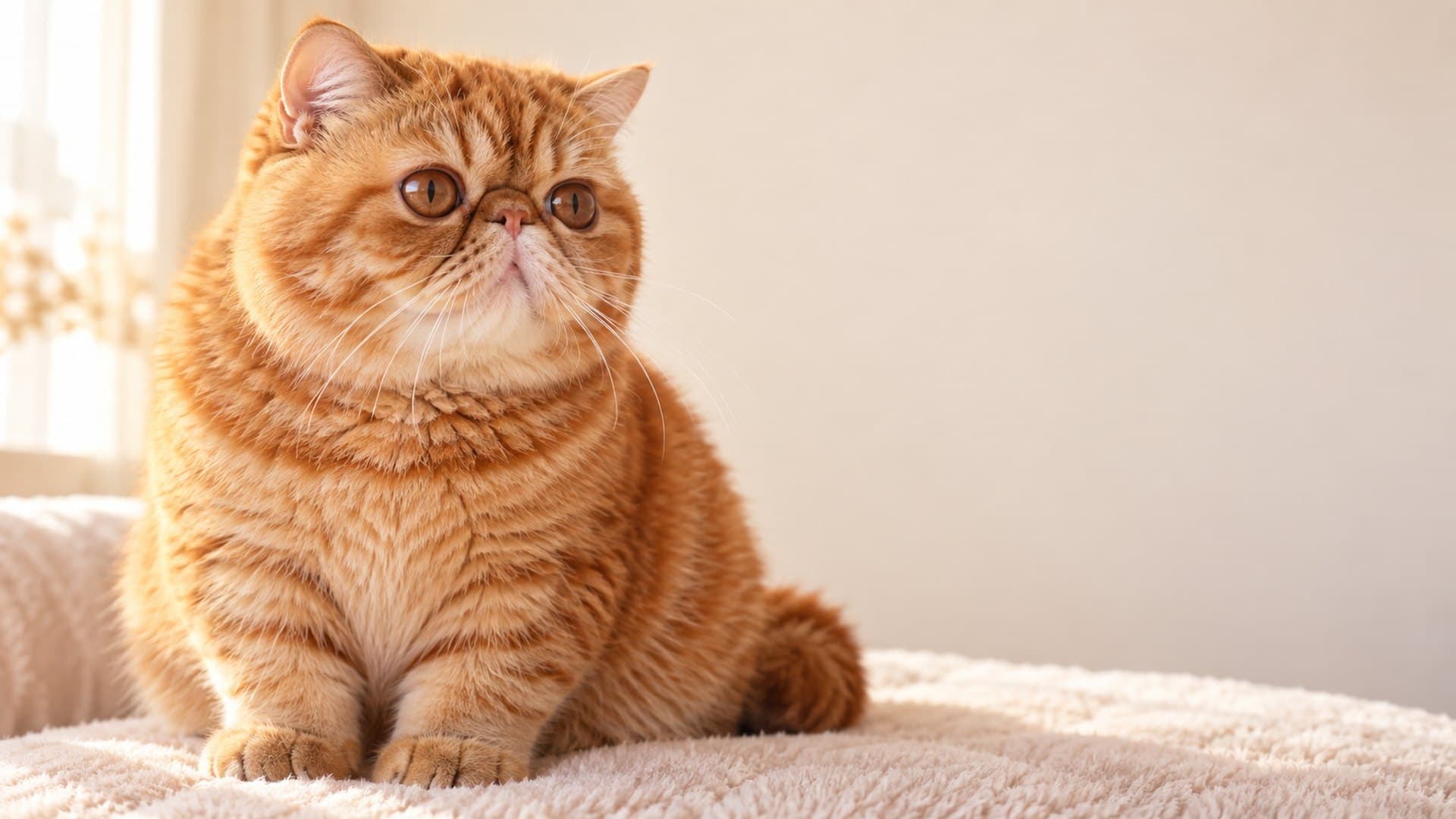
The Exotic looks like a Persian dressed in a short, plush coat. That's no coincidence: the breed really did come from crossing Persians with shorthaired cats. Here's how it happened, why the Exotic's coat is so dense, where longhaired kittens in a litter come from and what the flat face it inherited from the Persian means.
How the breed began
In the 1950s, several breeders in the USA began crossing Persians with American Shorthairs. Some wanted the silver color and green eyes of silver Persians; others were experimenting with type. The kittens were shorthaired but had the round head, short face and gentle nature of the Persian, and they soon won fans.
At first these cats met a mixed reception, since they didn't fit the standard of either parent breed. But in 1966–1967 CFA adopted a separate standard for them, based on the Persian standard, and recognized the new breed. The name “Exotic Shorthair” was chosen partly because many of the early cats were shaded silver or chinchilla, colors that didn't exist in any shorthaired breed at the time. FIFe recognized the Exotic in 1983. Today many registries, including the UK's GCCF, allow Exotics to be crossed only with Persians and other Exotics.
Why the coat is short and so dense
Coat length in cats is determined mainly by the FGF5 gene. Long hair is a recessive trait: a cat will be longhaired only if it inherits the “longhair” version of the gene from both parents. Short hair is dominant, which is why all first-generation kittens from a Persian and a shorthaired cat have short coats.
But the Exotic's coat isn't simply short. Standards describe it as dense, plush and soft, with a thick undercoat that makes it stand away from the body. That's why an Exotic is so pleasant to touch, and also why it sheds noticeably, especially seasonally. More on grooming in “Exotic care”.
Where longhaired kittens come from
Because Exotics were crossed with Persians for many generations, plenty of them are hidden carriers of the longhair gene. If both parents are carriers, each kitten has roughly a one-in-four chance of being born longhaired. These kittens look like Persians. Depending on the registry, they're recorded as Persians or as longhaired Exotics. It isn't a “defect” or a sign of an “impure” breed; it's ordinary genetics.
The flat face: a Persian inheritance
The FIFe standard is shared by Exotics and Persians; only the coat description differs. So the Exotic's head is round and massive, the eyes large and round, the nose short and broad. Along with this, the Exotic inherited the consequences of brachycephaly, a shortened skull. We covered this in detail in “Why Persians have flat faces”; in brief:
- narrowed nostrils and nasal passages can make breathing harder;
- misshapen tear ducts drain tears poorly, which causes tear overflow and streaks on the fur;
- shortened jaws can affect how the teeth are positioned.
A 2021 Swedish study that examined 76 show Persians and Exotics showed how common these features are: 86% of the cats had moderately or severely narrowed nostrils, 83% had tear overflow and 32% had inward-turning eyelids (entropion). Yet only the owners of 6 cats noticed breathing problems at least once a week. In other words, many people simply don't see snuffling as a problem.
What the standards say
The FIFe standard includes requirements that matter specifically for health: nostrils must be well open so air can pass freely, and the “stop” (the transition from forehead to nose) must sit between the eyes, neither above the upper eyelid nor below the lower one. So “the flatter the better” is not what the breed calls for. A moderate type with open nostrils fully meets the standard and is better for the cat.
What to look for in a kitten
- Open nostrils and quiet breathing with the mouth closed, even after play.
- Clean eyes with no redness or inward-turning eyelids.
- A moderate face type in both parents.
- The parents' DNA test results, covered in “Exotic health”.
Only a vet can give a final assessment of a kitten's breathing and eyes.
Learn more about the breed on the breed page. Available kittens, if there are any, are among our kittens of the breed, and if there are none right now, join the waitlist.


