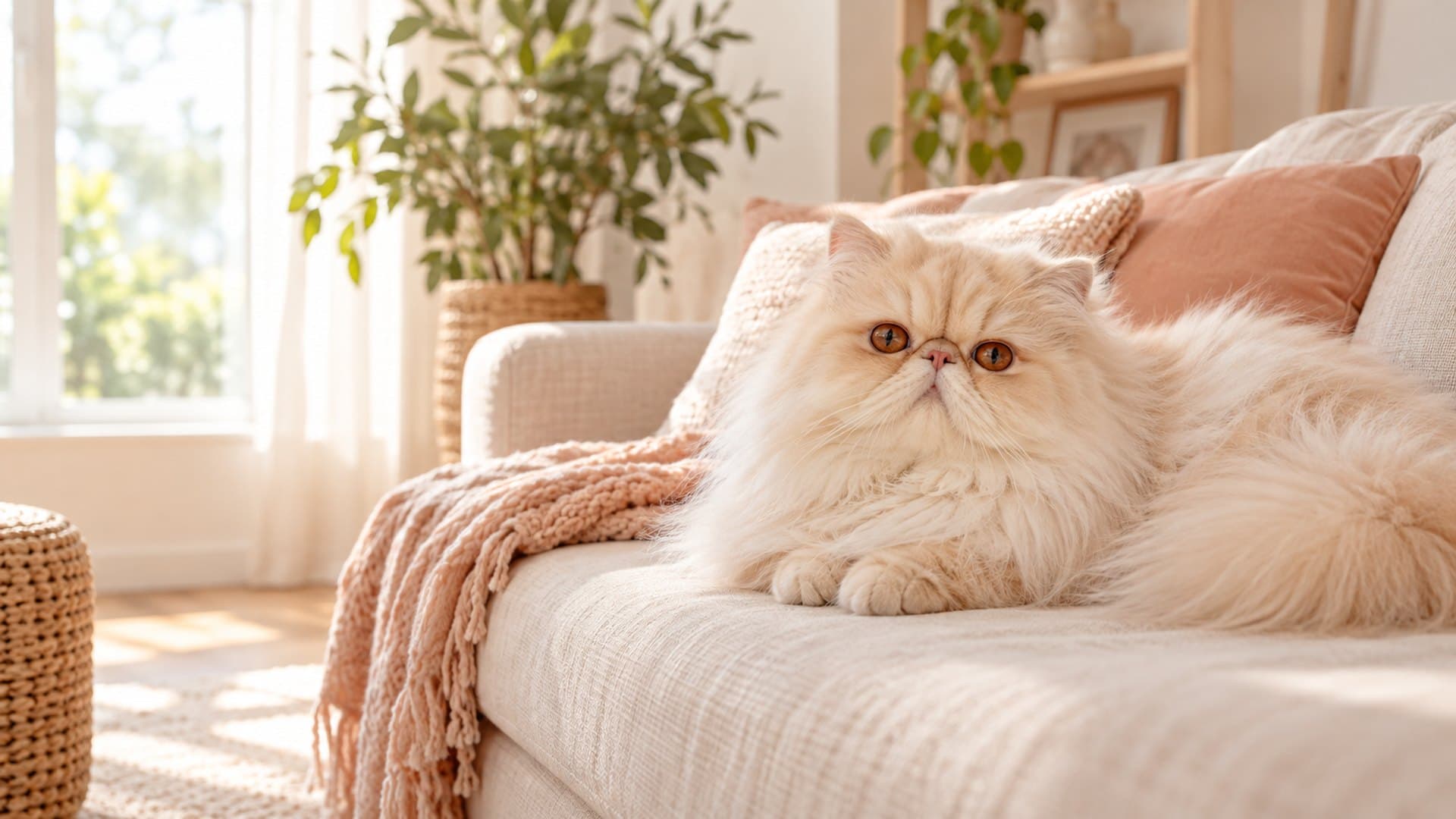

Why Persians have flat faces and what it means for health
Where the Persian's round head and short nose came from, what breed standards say, how skull shape affects breathing, eyes and teeth, and what to check in a kitten.
Published 4 min read

A big round head, wide-set eyes and a short nose: that face is how most people recognize a Persian at first glance. But head shape isn't only about looks. It affects how a cat breathes and how its eyes and teeth work. Here's where the “flat face” came from, what breed standards say about it and what it means for you as a future owner.
Where Persians came from
The traditional story links Persians to the East: in the 17th century, longhaired cats were brought to Europe from Persia (today's Iran) and Turkey. Genetic studies, however, show that modern Persians are closer to Western European cats than to cats from the Middle East; the breed as we know it took shape in Europe and the USA.
Persians were shown at London's Crystal Palace cat show in 1871, and, as GCCF notes, they had round heads but noticeably longer noses than today's cats. The biggest change to the Persian face came in the 20th century: breeders and judges favored cats with ever shorter noses and rounder heads, and the type became more fixed with each generation.
Brachycephaly in plain words
Brachycephaly means a shortened, widened skull. In brachycephalic cats the facial bones are shorter, the upper jaw is rotated upward and the nose sits closer to the eyes. You'll know the same build from dogs such as pugs and bulldogs.
Unlike the Munchkin's short legs, which come down to a single mutation, the Persian's flat face is the result of many genes. Researchers have found several regions in the Persian genome that set the breed apart from others, including genes linked to face shape in humans. In other words, this type was built through long-term selection, not by flipping one “switch” in the DNA. That's also why moving back toward a more moderate face is a job for careful breeding, not a single test.
What the standards say
Breed standards describe the Persian head as round and massive, with a short, broad nose. But they also contain requirements that are specifically about health. The FIFe standard for Persians and Exotics requires nostrils that are well open and allow free, easy breathing, and a “stop” (the transition from forehead to nose) positioned between the eyes: neither above the upper eyelid nor below the lower one. GCCF also explicitly calls for open nostrils.
In other words, the standard does not say “the flatter the better.” The extreme type, with the nose above eye level and slit-like nostrils, isn't the breed ideal; it's a risk to the cat.
How head shape affects health
International Cat Care lists the problems linked to marked brachycephaly:
- breathing: narrow nostrils, narrowed nasal passages and an elongated soft palate make it harder for air to pass;
- eyes: large, prominent eyes are harder for the eyelids to close over, so the cornea is more vulnerable to irritation and injury;
- tear overflow: misshapen tear ducts drain poorly, so tears run down the face and leave brown streaks;
- teeth: shortened jaws can leave teeth misaligned, making biting and chewing harder;
- skin: deep folds by the nose can become inflamed.
A study that examined 69 Persian cats with CT scans (Sieslack et al., 2021) found a clear pattern: the more severe the brachycephaly, the more the eyeballs protruded from their sockets, the lower the bony opening of the nose and the more often the upper premolars were displaced.
Not all Persians are alike
Persians vary a lot, from a moderate type with a visible little nose (breeders sometimes informally call it “doll face”) to very flat “extreme” cats. The degree of brachycephaly is also the degree of risk, so the moderate type is usually associated with fewer problems. Responsible breeders select cats with open nostrils, quiet breathing and healthy eyes.
What to look for in a kitten
- Nostrils: open, not slits. The kitten breathes quietly with its mouth closed, without snuffling, even after play.
- Eyes: clean, not overly prominent, with eyelids that close properly. Mild tearing is common; thick yellow or green discharge is not.
- Nose: the stop sits between the eyes, not above them.
- Bite: ask to see the kitten's teeth.
- Parents: see both if you can, and ask about polycystic kidney disease (PKD) testing.
More about tests and checkups in “Persian health”. Only a vet can give a final assessment of a particular kitten's breathing and eyes.
Learn more about the breed on the breed page. Look for available kittens, if there are any, among our kittens of the breed, and if there are none right now, join the waitlist.