

Why the Russian Blue looks silver: coat, eyes and origins
Archangel cats, sailors and Victorian cat shows: where the Russian Blue came from, why its coat shimmers silver and why its eyes turn green with age.
Published 4 min read
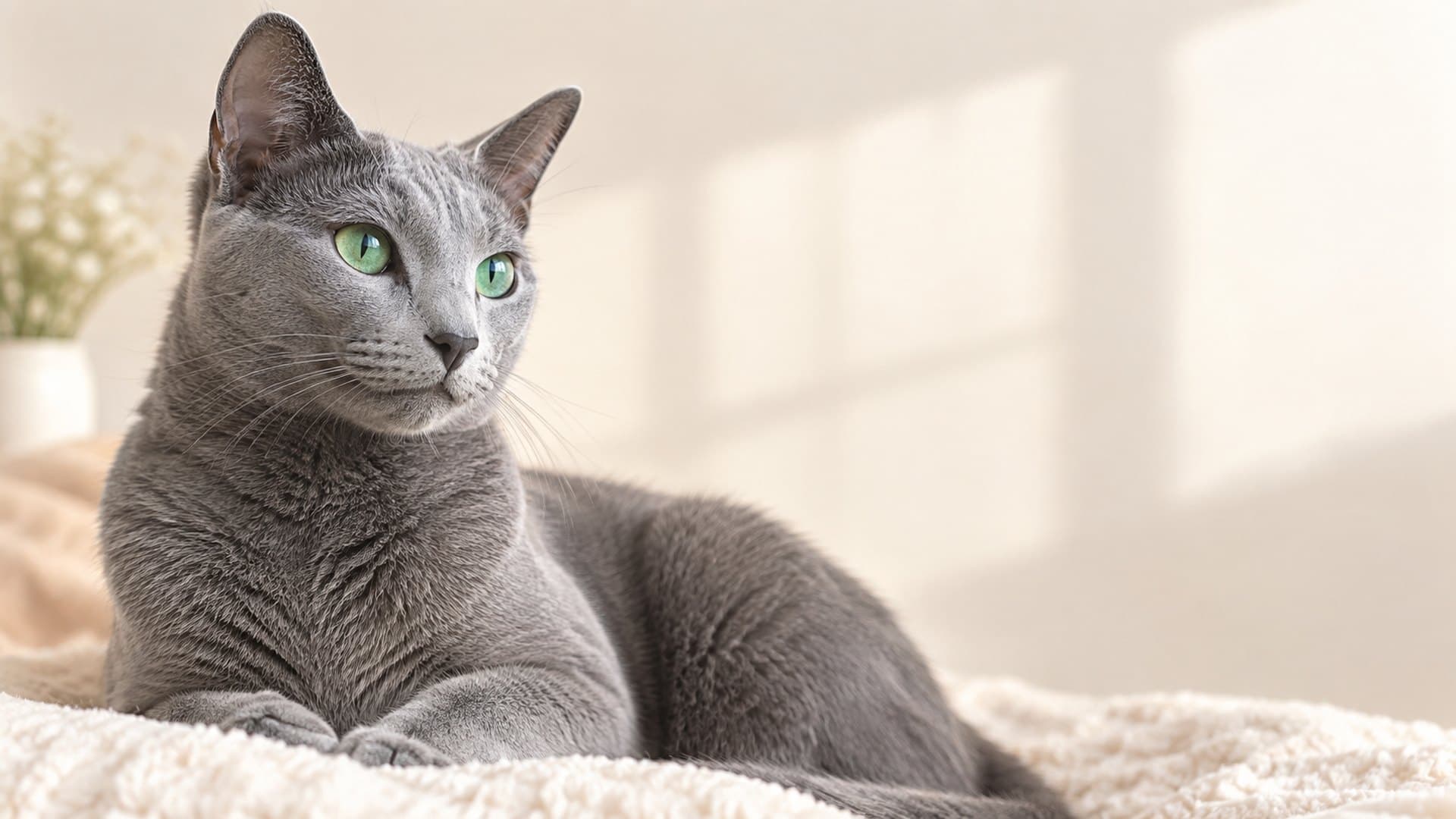
Look closely and the Russian Blue is hard to mistake for any other cat: the dense blue-grey coat looks dusted with silver, and bright green eyes glow against it. This is a natural breed, meaning it developed without deliberate human design, and breeders have simply preserved and refined its traits. Here's where the Archangel cats came from, how their colour works and what the breed standards say.
The Archangel cats
The breed is believed to come from the region around Arkhangelsk and the Archangel Isles in northern Russia. There's almost no written record of its early history, but the most widely told version is that sailors on trading ships brought the cats to England and northern Europe. As the story goes, one such cat, named Kola, was swapped for a leg of mutton at the London docks in 1890.
In 1875 a cat billed as an “Archangel Cat” was shown at London's Crystal Palace. At first these cats competed in a single class with all other blue cats, whatever their type, and only in 1912 did the breed get a show class of its own.
Through the wars to the modern breed
In the first half of the 20th century, Scandinavian breeders played a big part in developing the breed. The Second World War brought the Russian Blue close to extinction, and to rebuild numbers breeders had to use outcrosses, including to Siamese cats.
After the war, American breeders imported cats from Europe and combined the English and Scandinavian lines. That's how the modern Russian Blue took shape: graceful, fine-boned, long-legged and with that distinctive dense coat.
Where the blue comes from
In cats, blue is a “diluted” black. It's caused by a recessive dilution gene: the pigment in each hair is distributed unevenly, in clumps, so black is seen as blue-grey. To be blue, a kitten has to inherit this gene from both parents. That's why two blue parents have blue kittens.
Most associations, including the CFA and FIFe, only recognise the blue colour. The UK's GCCF also recognises Russian Whites and Russian Blacks, which were first bred in the 1960s. And the Russian Blue's longhaired relative is a separate breed, the Nebelung.
Silver sheen and a double coat
The secret of the shimmer is in the tips of the guard hairs: they're lighter and silvery, so the coat seems to sparkle in the light. The standards describe the Russian Blue's coat as a short, very dense double coat with a thick undercoat that makes the fur stand out from the body rather than lie flat. It feels soft and silky, quite unlike the coat of any other breed.
Because the coat is so dense, the cat looks bigger than it really is. Underneath is a graceful, muscular, medium-sized body.
Green eyes come later
Vivid green eyes are one of the breed's trademarks, but kittens aren't born with them. At first their eyes are bluish, like all kittens' eyes, then yellowish, often with a green ring around the pupil. The green gradually deepens, and this can take months or even more than a year. So don't worry if your kitten's eyes aren't emerald yet.
What the standard says
The standards of different associations vary in the details, but the overall picture is the same:
- a graceful, medium-sized body on long, slender legs;
- a medium-length, wedge-shaped head;
- large, wide-set ears;
- wide-set, vivid green eyes;
- a dense blue coat of even colour with a silvery sheen.
People often say the Russian Blue wears a faint smile, because the corners of its mouth turn up slightly. That “smile”, together with the silver shimmer, gives the cat a particularly striking expression.
What it means day to day
The breed's features suggest a few practical points:
- brushing the dense double coat once a week is usually enough, but do it more often while it sheds, because more fur comes out than you'd think;
- the thick coat makes it hard to judge your cat's shape by eye, so weigh it regularly and feel for the ribs;
- a kitten's eye colour will still change, so when choosing, look at its parents' eyes;
- the silver sheen shows best on a healthy coat, so if the fur turns dull, talk to your vet.
We cover everyday care for this coat in our article “Russian Blue grooming”.
You'll find more about the breed on the breed page and in our article “Russian Blue personality”. You can check the site to see whether any kittens of this breed are available right now, and if not, join the waiting list.


