
Why is the Maine Coon so big? Origins, genetics and the standard
Where the Maine Coon gets its size, shaggy coat and tufted ears, how long it keeps growing, and what breed standards and veterinary genetics say.
Published 4 min read

The Maine Coon is widely seen as the biggest domestic cat breed: the American association CFA calls it “the largest of all pedigreed cats”. But where does that size come from? The answer lies in the harsh climate of the north-eastern United States, natural selection and the work of breeders. Here, in plain words, is how this giant came about and what it means for an owner.
A cat from the farms of Maine
The Maine Coon is a natural, or native, North American breed. Its ancestors were most likely cats that arrived in New England with European settlers and sailors. On the farms and in the ports of Maine, the cats that survived and bred were those best able to cope with long snowy winters and to hunt rodents. Generation by generation, this produced a type of large, sturdy cat with a thick coat.
Maine Coons were already being shown at agricultural fairs in New England in the 1860s, and in 1895 a brown tabby female called Cosey won at the first major cat show in the United States. In the early 20th century the breed was pushed aside by more fashionable Persians, but enthusiasts brought it back: the Maine Coon gained championship status with the CFA in 1976 and later became the official state cat of Maine.
Why so big?
Its large size is the result of many genes working together, not a single giant gene. Natural selection in a cold climate is thought to have favoured a large, sturdy body that holds heat better, and breeders later fixed these traits in the standard. So a Maine Coon's size is mainly about body length, bone and muscle, not fat.
Adult males often weigh 7–9 kg, while females are usually noticeably smaller, although there is a wide range within the breed. Guinness World Records for the longest domestic cat have more than once gone to Maine Coons, at around 1.2 metres from nose to tail tip. But records are no measure of quality: a healthy Maine Coon of average size for the breed is in no way inferior to a giant.
Slow to mature
The Maine Coon keeps growing for a long time. According to the CFA it can take up to three years to reach full size, and the UK's GCCF mentions four. So a six-month-old kitten is still very much a teenager, and the final build only shows with time. Don't overfeed “for growth”: extra weight doesn't make the cat bigger, it just loads the joints. How much and what to feed a growing cat is best discussed with your vet.
Features built for winter
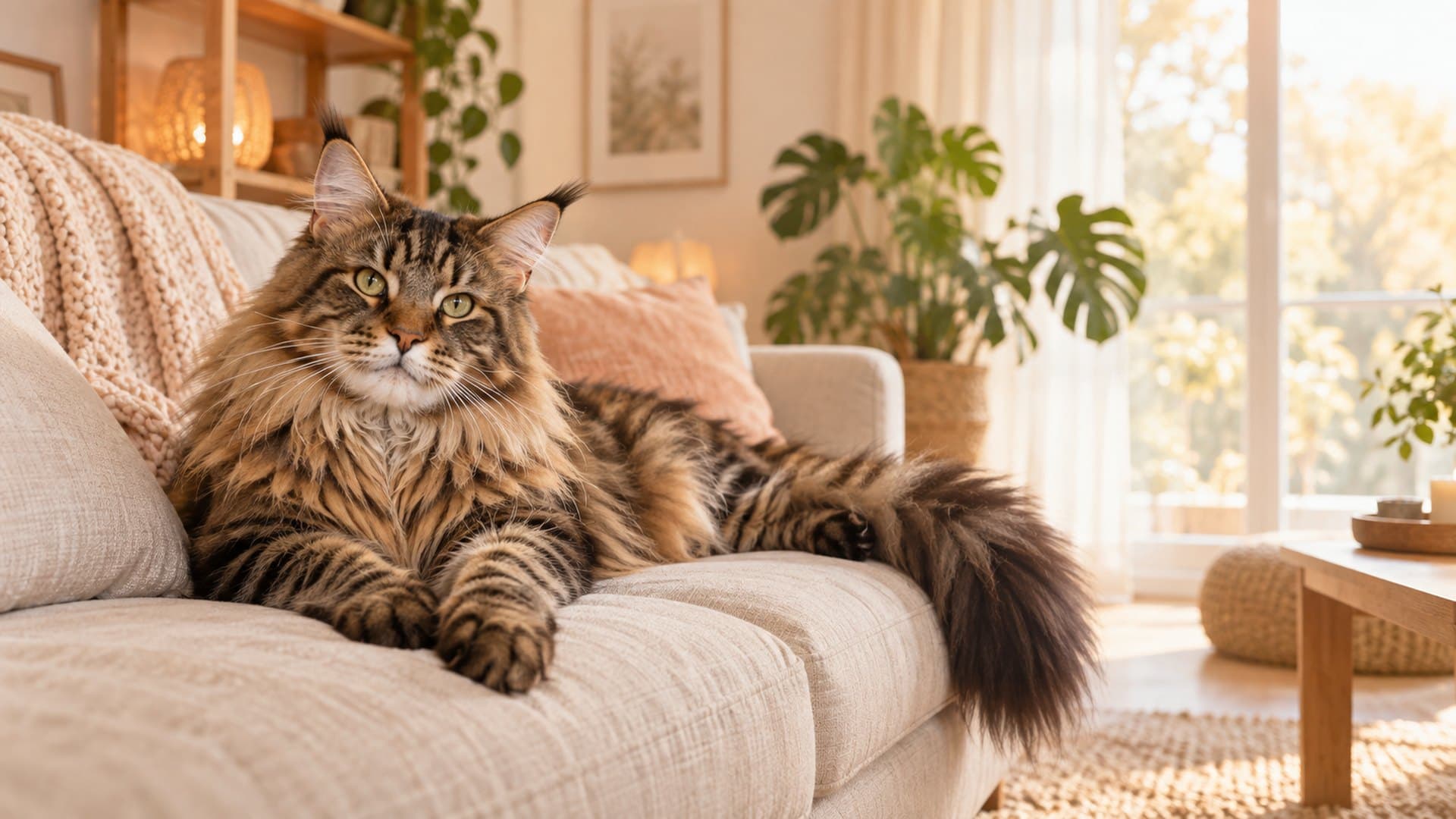
The standard describes the Maine Coon as a large cat with a long, rectangular body, strong bone and a broad chest. Each of its characteristic features has a practical origin:
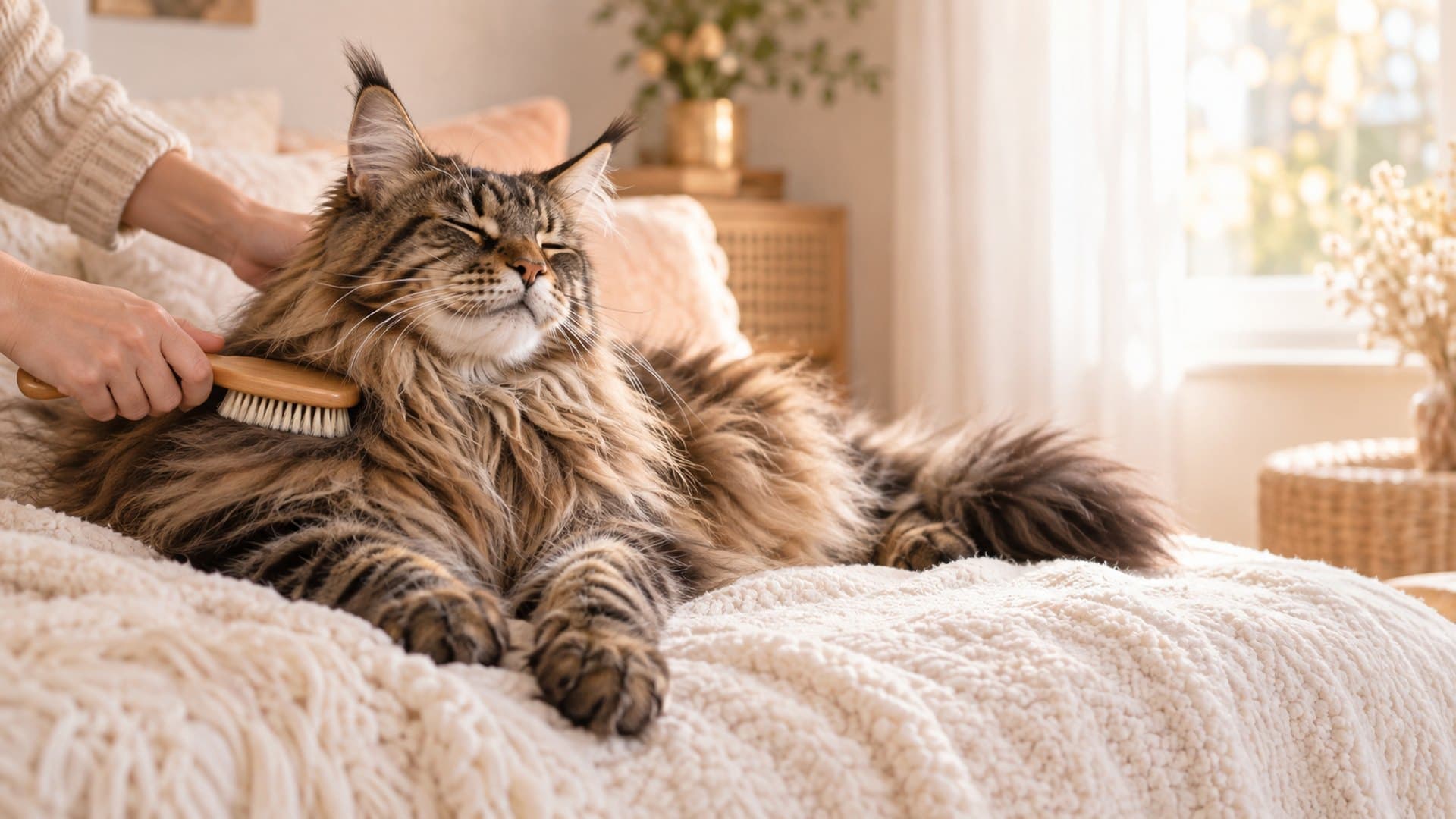
- a thick, shaggy coat, shorter on the shoulders and longer on the belly and britches, which is water-resistant and protects against snow and damp;
- a full ruff around the neck and a long tail the cat can wrap around itself when curled up;
- big paws with tufts of fur between the toes that act like snowshoes;
- large ears with lynx tips and furnishings inside, better protected from the cold.
Extra-toed, or polydactyl, cats were common among early Maine Coons. Today most registries don't allow them in the show ring, but since 2015 TICA has recognised the Maine Coon Polydactyl as a separate variety.
Almost any colour is possible, but the classic is brown tabby, the “raccoon” colouring that gave the breed its name.
A big cat, a bigger responsibility
Size has a downside. A study of X-rays collected by the Orthopedic Foundation for Animals (OFA) in the USA found hip dysplasia in almost a quarter of the Maine Coons screened, and the authors believe even that figure is an underestimate. Signs can include reluctance to jump, stiffness after sleep or a change in gait, but in many cats hip dysplasia goes unnoticed for a long time. It is diagnosed by X-ray; there is no DNA test for it.
Maine Coons are also known to be affected by an inherited form of hypertrophic cardiomyopathy (HCM) linked to the A31P mutation in the MYBPC3 gene, and by spinal muscular atrophy (SMA). There are DNA tests for both, and the heart is also checked by ultrasound, because HCM can occur without the known mutation. Responsible breeders test their cats, while diagnosis and treatment of an individual cat are a matter for your vet.
The takeaway
The Maine Coon is big thanks to a combination of natural selection in a harsh climate and many genes that shape its bone and build. It grows slowly, needs space and a lean weight, and its health is supported by genetic tests and screening of the parents.
There's more about the breed on the breed page and in “Maine Coon myths”. Look for available Maine Coon kittens, and if there are none right now, join the waiting list.