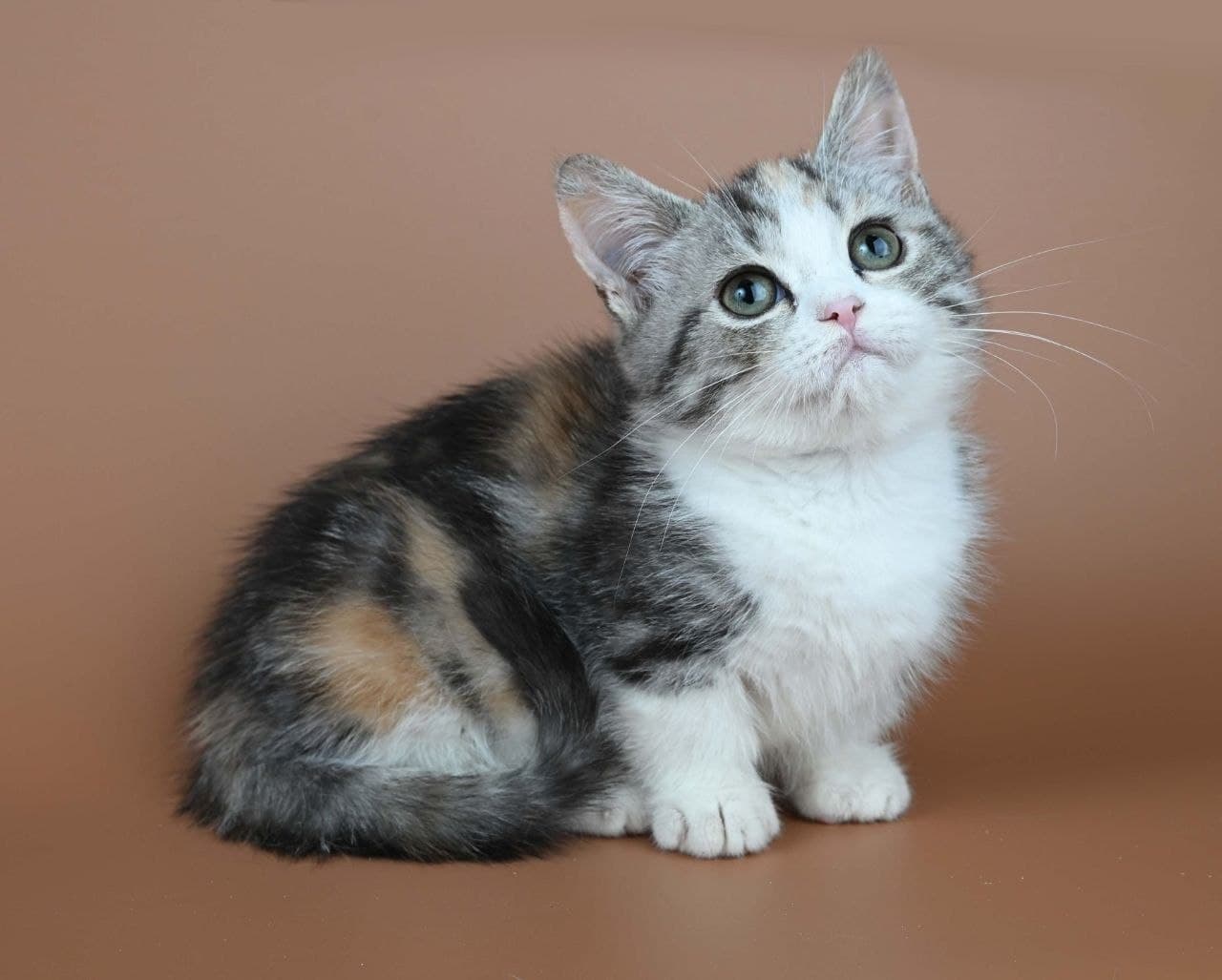

Why Do Munchkin Cats Have Short Legs? Genetics and Health
Munchkin short legs come from a natural dominant mutation linked to the UGDH gene. How it is inherited, breed history, who recognises it, the health debate.
Published 7 min read

Munchkin cats have short legs because of a natural mutation that makes the long bones of the limbs grow shorter, a form of chondrodysplasia, or disproportionate dwarfism. The mutation is dominant: one copy from one parent is enough, while two copies appear to be incompatible with embryo development. In 2020 two independent research teams linked the trait to a structural variant of the UGDH gene on cat chromosome B1.
What exactly is shorter
In a short-legged munchkin, the long bones of all four legs are shortened, while the body, head and tail keep normal proportions. It is not a miniature breed: according to TICA, an adult munchkin weighs roughly 5 to 9 pounds (2.3 to 4 kg), like an average-sized cat.
The most detailed description comes from researchers at the University of Veterinary Medicine Hannover. A CT scan of a four-year-old male showed front-leg bones that were much shorter and thicker than in a typical cat, with one forearm bone visibly bowed, while the head showed no signs of dwarfism.
Breeders call short-legged munchkins "standard" and normal-legged littermates "non-standard"; here we simply say short-legged and normal-legged.
How short legs are inherited
Let M stand for the short-leg variant and m for the normal one.
- Mm is a short-legged munchkin. Every short-legged munchkin carries exactly one copy.
- mm is a normal-legged cat.
- MM means two copies. These embryos are thought to die early in pregnancy: in a 2020 study, none of the 42 short-legged munchkins tested had two copies.
That is why pairings differ:
| Parents | What to expect on average |
|---|---|
| Short-legged × normal-legged | About half the kittens short-legged, half normal-legged |
| Short-legged × short-legged | About a quarter of embryos do not develop, so litters are smaller; of the kittens born, roughly two thirds short-legged and one third normal-legged |
| Two normal-legged cats, even with munchkin parents | All kittens normal-legged |
These are probabilities, not guarantees, and any single litter can differ. Both breeders and researchers have noted smaller litters when two short-legged cats are mated.
Normal-legged kittens in munchkin litters are expected, not a defect. Genetic testing shows they do not carry the mutation, so they cannot pass short legs on. Under the WCF standard, such cats may be used for breeding but not shown.
What geneticists found
For years all that was known was that the trait is dominant, as shown by the breeding records TICA collected from the mid-1990s. Researchers then narrowed the search to a region of chromosome B1, and in 2020 two papers pointed to a specific gene.
- Buckley R. M., Davis B. W., Brashear W. A. et al. (including Lyons L. A., Murphy W. J. and Warren W. C.), 2020, PLoS Genetics 16(10): e1008926. A team led from the University of Missouri and Texas A&M built a new, more accurate cat genome assembly and found a complex structural variant disrupting UGDH in three unrelated cats with dwarfism.
- Struck A.-K., Braun M., Detering K. A. et al. (senior author Distl O.), 2020, BMC Genetics 21: 67. The Hannover team described a variant in the same gene: a deletion of about 3,300 DNA base pairs with a small insertion. All 42 short-legged munchkins tested carried it; none of the 15 normal-legged munchkins or 203 cats of other breeds did.
UGDH encodes the enzyme UDP-glucose 6-dehydrogenase, which is needed to make glycosaminoglycans, molecules that are part of cartilage and help regulate bone-growth signals. The authors call the variant the most likely cause of the short legs; exactly how it shortens the bones is still being studied. A DNA test can already show whether a cat carries it.
Breed history
Short-legged cats were reported long before the breed existed: TICA cites a 1944 British veterinary report describing four generations of them. The modern breed began in Louisiana in 1983, when Sandra Hockenedel found a pregnant short-legged female cat and named her Blackberry. She gave a male from one of Blackberry's litters, Toulouse, to her friend Kay LaFrance. The breed descends from these two cats, outcrossed to ordinary domestic cats to keep the gene pool broad.
TICA accepted the munchkin into its New Breed development program in September 1994, and the breed has held TICA championship status since May 2003.
Which associations recognise the breed
| Association | Status | What the documents say |
|---|---|---|
| TICA | Recognises | Championship status since May 2003 |
| WCF | Recognises | Published breed standard (revised 8 December 2021); normal-legged cats allowed for breeding only, not for shows |
| CFA | Does not recognise | No munchkin class of any kind in the 2026–2027 show rules |
| FIFe | Does not recognise; prohibits | Its Breeding & Registration Rules (issued 1 July 2026) name the munchkin as an example of a breed FIFe will not register; such cats, and cats with them in their ancestry, may not be bred |
| GCCF | Does not recognise | Listed under "red status" as ineligible due to reported health problems |
In practice this means a munchkin pedigree can come from a WCF or TICA club. There is no such thing as a FIFe pedigree for a munchkin.
Do short legs harm health?
This is the most contested question about the breed. The honest answer: there are no large health studies of munchkins, and the positions of breed supporters and welfare groups differ sharply.
What has been confirmed
The leg bones are altered in shape, not only in length. In a University of Missouri study (Anderson L. M. et al., Veterinary and Comparative Orthopaedics and Traumatology, 2021), radiographs of all five cats with disproportionate dwarfism showed bone deformities in every limb, including bowing and rotation of forearm and shin bones. Spinal MRI of two cats found no pathology, and the authors called the findings on disc degeneration inconclusive. With so few cats, this is an early observation, not a final answer.
Osteoarthritis
The UK welfare charity UFAW (now Science for Animal Welfare) says abnormal loading of the joints may increase the risk of osteoarthritis and recommends that cats with this condition should not be bred. A vet-reviewed breed profile on PetMD also describes munchkins as prone to arthritis and mobility problems. TICA takes the opposite view, stating that a cat's spine is built differently from a dog's, so the short legs do not cause the back problems seen in dachshunds. The Hannover authors wrote that short-legged munchkins have reduced leg length without impaired health, but they examined only a few cats.
Lordosis and pectus excavatum
Lordosis (an excessive downward curve of the spine) and pectus excavatum (a sunken, funnel-shaped chest) are often listed as conditions to watch for in this breed. Both are congenital, and a severe chest deformity can press on the heart and affect breathing. How common they actually are in munchkins has not been established by large studies.
What this means for owners
Short legs change the skeleton, not just the look, so joint risks later in life cannot be ruled out; yet the claim that every munchkin will inevitably suffer is not supported by data either. In practice:
- choose a kitten whose parents have been examined by a vet, and ask the breeder about their health;
- take your kitten for a vet check after it moves in, and keep up with routine examinations;
- keep your cat at a healthy weight, since extra weight loads the joints;
- if your cat stops jumping, limps, moves stiffly or breathes heavily, see a vet without waiting.
This article is not veterinary advice; only a vet can assess an individual cat.
How short legs affect daily life
Munchkins are lively and curious. TICA describes them as fast runners with sharp cornering who love chasing toys. Practical points for the home:
- Jumping. A munchkin will not leap from the floor onto a wardrobe in one go; it climbs in stages: chair, sofa, windowsill. Its jumps really are lower than an ordinary cat's.
- The "kangaroo" pose. To get a better view, munchkins often sit up on their hind legs like a rabbit or a kangaroo.
- Steps and ramps. Put them by the bed, the sofa and a favourite windowsill to reduce joint impact when jumping down.
- Furniture. Choose cat trees with a low first level and wide platforms, a low-entry litter box, and vertical and horizontal scratching posts.
- Measured meals. PetMD advises against free-feeding: munchkins gain weight easily, and extra weight puts more load on the back and legs.
- Grooming. Shorthaired munchkins need combing about once a week, longhaired ones twice.
We cover temperament in our article on munchkin personality, and the breed overview is in our munchkin guide.
In short
- Short legs come from a natural dominant mutation, most likely a UGDH variant (2020 studies in PLoS Genetics and BMC Genetics).
- Two copies are not viable, so short-legged pairs have smaller litters; normal-legged kittens carry no mutation.
- TICA and WCF recognise the breed; CFA, FIFe and GCCF do not.
- Joint and spine risks are debated without large studies, so regular vet checks matter.
If you have already decided a munchkin is right for you, meet the kittens looking for a home now.