
Personality and home life: living with a Ragdoll
What Ragdoll cats are like at home, how they play and which families suit them.
Published 4 min read

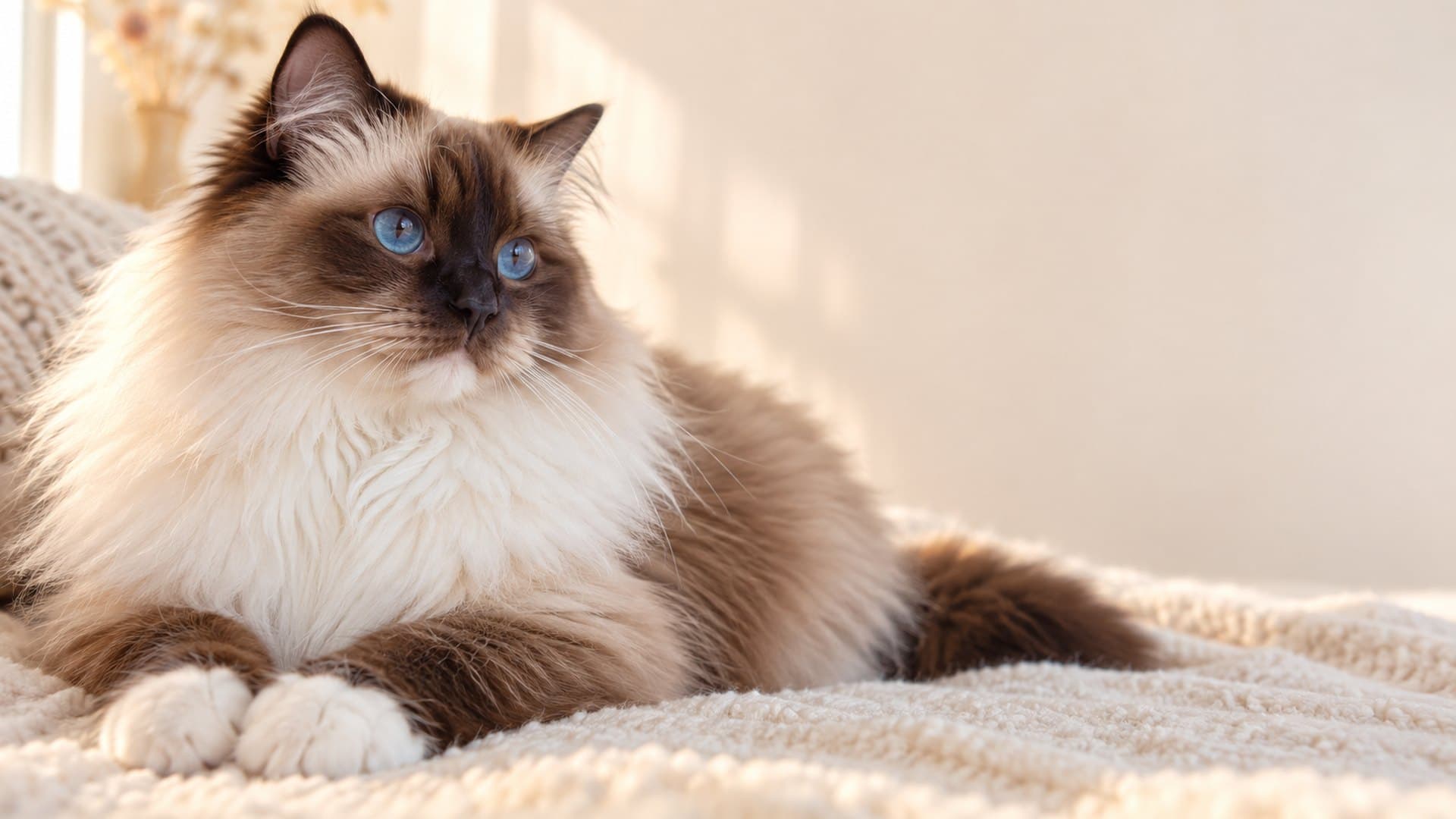
The Ragdoll is a large, semi-longhaired cat with blue eyes and pointed colouring. It is often described as an easy-going companion that enjoys being close to people. This is a typical breed portrait, not a promise about any individual cat. Kittens vary, and their environment and early experiences matter too.
Everyday temperament
Many Ragdolls follow their people and settle nearby, but not every one enjoys being held. A calm expression does not mean indifference: the cat notices changes in household rhythm and looks for predictable contact. Peace at home also depends on letting a cat choose its distance. Do not demand cuddles simply because a breed is described as affectionate. Watch body language and reward contact the cat chooses freely.
Play and activity
A young Ragdoll can be very lively, while an adult usually prefers moderate but regular play. Its large body needs sturdy, stable climbing furniture, and a placid manner does not remove the need for exercise. Short daily sessions with a wand toy, ball or puzzle feeder let natural hunting behaviour have an outlet. Wind play down calmly, and put strings and small parts away when nobody is watching. Rotate toys to keep them interesting.
Children and other pets
Ragdolls often get on with children and other animals when treated gently. Tolerance is no licence to carry a cat like a toy: support its large body with both hands and let it go when it wants to leave. Introduce another cat or dog gradually, with separate resources, scent exchange and brief supervised meetings. Show children how to invite a cat to play without grabbing it.
Time alone
A cat can spend a few hours alone with water, a safe space and things to do, but it still needs daily contact with its family. Every cat needs a predictable routine, a clean litter tray, fresh water, places to rest and somewhere to hide. Even a sociable cat must be free to end an interaction. Children should learn not to wake an animal or hold it against its will.
Who this breed suits
This breed best suits a family ready to respect feline boundaries, play every day and avoid expecting every individual to behave alike. Before choosing a kitten, spend time watching it in a calm setting. Ask the breeder about its habits, response to unfamiliar people and daily routine. A breed description helps you ask better questions, but it cannot replace meeting the individual cat.
What to observe before choosing
Character shows up in specific situations: how a kitten responds to a new toy, an unfamiliar sound, touch and a pause in play. One short video is not enough to judge. Ask to see an ordinary part of its day and allow it to approach in its own time. A quiet cat is not necessarily inactive, and a lively one is not necessarily badly behaved.
A Ragdoll needs wide resting places, a stable cat tree and a spot near its family. It can thrive in a flat with play, a safe window view and freedom to rest without being disturbed. The soft semi-long coat usually lacks an excessively dense undercoat, but it can still tangle under the arms, on the belly and behind the ears. White 'mittens' in the mitted pattern are part of its colouring, not a separate breed. A breed-associated MYBPC3 variant is linked to hypertrophic cardiomyopathy (HCM) risk in Ragdolls. A negative DNA result for this single variant does not rule out every form of HCM or replace heart examination. The breed developed in the United States in the second half of the twentieth century. Selective breeding established its substantial size, soft silky coat, blue eyes and gentle temperament; the name reflects the way some cats relax when held.
When meeting the breeder, ask for veterinary records and a description of the kitten’s usual routine. Prepare questions in advance and note the answers so you can compare them calmly with your own circumstances. After the move, change the household routine gradually and keep familiar places for sleeping, eating and play. No breed comes with a health guarantee. Ask about parental screening, relevant test results, rearing conditions and the kitten's own veterinary records. A DNA test answers a question about a particular gene variant; it does not replace a clinical examination.
Read more on the breed page. Check the site for available kittens; if none are available now, you can join the waiting list.