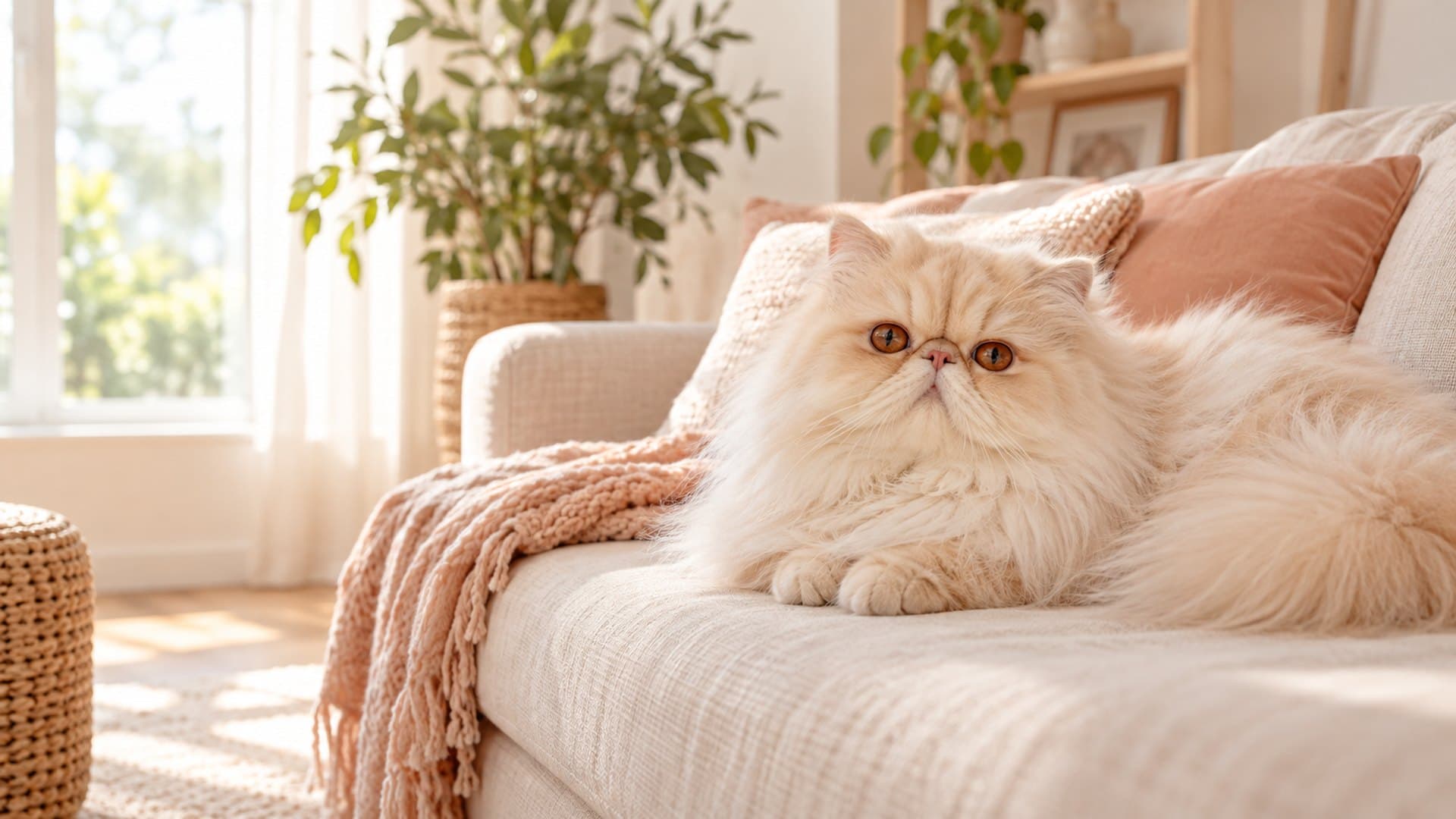

Myths about Persian cats: what's true and what isn't
A lazy “sofa cat,” an ancient breed from Persia, “the flatter the better,” kidney disease and fur allergy: we look at common beliefs about Persians and the facts.
Published 4 min read

People say a lot about Persians, and not all of it is true. Some myths make the breed sound easier than it is; others scare people for no good reason. We've gathered six common claims and looked at each one: what's true about it and what you actually need to know.
“Persians are lazy cats that don't need anything”
The truth: Persians really are calmer than many cats and rarely chase each other across the wardrobes. But CFA describes them as playful yet placid. Most Persians happily play with a wand toy or a ball, just not for long. Short daily play sessions are as good for them as for any other cat: they release energy and help keep weight in check. To tempt a laid-back cat, choose floor-level games: a wand toy that creeps along like a mouse, or a rolling ball.
One more thing: a calm nature doesn't mean a Persian doesn't need people. It wants attention, affection and daily combing, without which its coat quickly forms painful mats.
“It's an ancient breed straight from Persia”
The truth: there's a grain of truth here: longhaired cats really were brought to Europe from Persia and Turkey in the 17th century. However, a 2008 genetic study found that modern Persians are closer to Western European cats than to cats from the Middle East. And their current look, with a round head and a very short nose, was shaped by selective breeding in the 20th century. The first Persians shown at 19th-century cat shows had noticeably longer noses.
“The flatter the face, the better the Persian”
The truth: no. An excessively shortened face is linked to breathing, eye and dental problems. Modern standards, including FIFe's, require well-open nostrils that allow free breathing, and the transition from forehead to nose should sit between the eyes, not above them. A moderate kitten with open nostrils isn't a “lesser” Persian; it's often a healthier one. More in “Why Persians have flat faces”.
“Tears and snuffling are just part of the breed”
The truth: only partly. Mild tearing is very common in flat-faced cats, so wiping the eyes daily is a normal part of care. But noisy breathing, snoring, open-mouth breathing, breathlessness after play, thick yellow or green eye discharge, redness or squinting are not “normal for the breed.” They're a reason to see a vet. A 2021 Swedish study found that 86% of show Persians and Exotics had moderately or severely narrowed nostrils, yet only a handful of their owners had noticed breathing problems. In other words, it's easy to get used to snuffling and stop noticing it.
“All Persians have polycystic kidney disease”
The truth: this fear is out of date. In the 1990s, polycystic kidney disease (PKD) was found in more than a third of Persians. Since then, a simple DNA test for the PKD1 mutation has become available, and responsible breeders have removed carriers from their programs. It's one of the best-known success stories of genetic testing in cats. In a large 2022 genetic study, not one of the 118 Persians tested carried the mutation. The risk hasn't disappeared completely, though, so always ask to see the test results for both of a kitten's parents.
“People are allergic to fur, and Persians have too much of it”
The truth: the main cat allergen is a protein called Fel d 1. It's produced mostly in the skin's sebaceous glands and ends up on the fur, partly through saliva when the cat grooms. All cats produce it, and according to the available data, coat length doesn't affect how much. What does vary is the individual cat: for example, intact males produce more of it than neutered ones. So there's no such thing as a hypoallergenic cat: neither a longhaired Persian nor a shorthaired breed guarantees you won't react. If someone in your family has allergies, talk to an allergist before choosing a kitten and spend some time around cats first.
Where to find the facts
Reliable sources include breed standards from cat registries (CFA, FIFe, GCCF), International Cat Care and your vet. For a particular kitten, ask the breeder: how the parents behave, which tests they've had, how the kitten breathes and plays. A good breeder is happy to answer these questions and show the paperwork. Be wary of ads promising a “hypoallergenic” or “completely trouble-free” Persian: an honest description of the breed always covers both its strengths and its risks.
Learn more about the breed on the breed page. Available kittens, if there are any, are among our kittens of the breed; if there are none right now, join the waitlist.