
Why the Devon Rex is curly: the story of Kirlee and KRT71
A cat from an abandoned mine, crosses with Cornish Rex and a second gene: where the Devon's wavy coat came from and what the standard says about it.
Published 4 min read

A wavy coat, huge ears and an elfin face — you can't mistake a Devon Rex for any other breed. But its curls are not the result of any human tinkering; they are a natural genetic trait. Here is how the first Devon was spotted in England, why it was first mistaken for a Cornish Rex, what happens in the genes and what the breed standard says.
A cat from an abandoned mine
The breed's story began in the small town of Buckfastleigh in Devon, England. In the late 1950s, a local woman named Beryl Cox took in a stray tortoiseshell-and-white cat, who went on to have kittens. Among them was a dark male with a curly coat, who was named Kirlee. His father was probably a curly-coated feral tom that lived near an abandoned tin mine and was never caught.
Kirlee became the founder of the breed: according to the UK registry GCCF, the pedigree of every Devon Rex in the world goes back to him.
Not a Cornish: a second gene
Ten years earlier, another curly breed had already appeared in neighboring Cornwall — the Cornish Rex. After seeing a newspaper photo of a curly cat, Beryl Cox contacted its breeders, and everyone assumed that Kirlee carried the same gene. He was mated with Cornish Rex females, but every kitten was born with a straight coat.
That meant the Devon's and the Cornish's curls were caused by different genes. So the two breeds went their separate ways: the Devon Rex was recognized in the UK in 1967, and crossing it with the Cornish has been considered undesirable ever since. Other curly mutations were later found in various countries, such as the Selkirk Rex in the USA. Each is a separate mutation, so the word Rex in a breed's name only means a curly coat, not a family connection.
What happens in the genes
The Devon gene was only identified in 2010, by researchers at the University of California, Davis (UC Davis). It turned out to be KRT71, the gene for keratin 71, a protein involved in forming a hair inside the follicle. The change makes the hair weaker and bent, so the coat falls into waves.
The key points in plain words:
- the trait is recessive: a kitten is curly only if it inherits the Devon version of the gene from both parents;
- a Devon crossed with a straight-coated cat produces straight-coated kittens that are carriers;
- the same gene has another version — the Sphynx one, which makes a cat almost hairless; it is dominant over the Devon version, so the Sphynx and the Devon are closely linked genetically, and crossing them in breeding programs is not allowed because it muddles both breeds;
- a DNA test can show whether a cat carries the Devon variant.
A closer look at the Devon coat
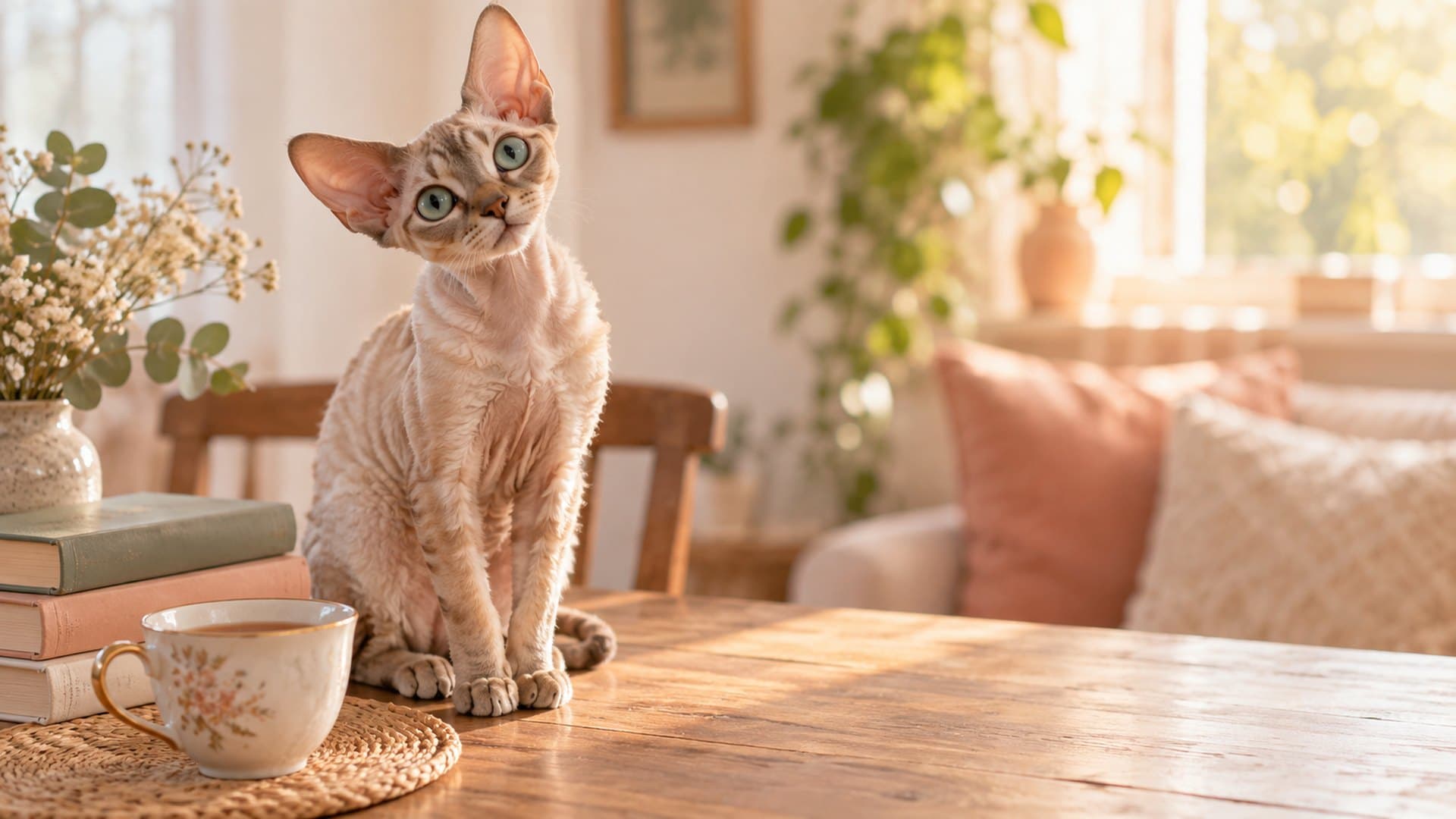
An ordinary cat's coat is made up of three types of hair: long guard hairs, intermediate awn hairs and soft down. A Devon has all three, but there are few guard hairs and they are altered, so the coat is short, soft and wavy. According to the GCCF standard, the waves are most visible on the back, sides and tail. On the top of the head, the neck, chest and belly the coat can be much shorter and downy, which is normal for the breed. The whiskers and eyebrows are crinkled too, brittle and often short.
Kittens have an interesting quirk. Most are born with a wavy coat, but from about eight weeks many lose a large part of it and are left with a short, suede-like fuzz. The coat then grows back gradually, and a Devon usually doesn't have its full adult coat until at least six months, often later. There is no need to worry about this, but bald patches in an adult cat are a reason to see the vet.
We explain how to care for such a delicate coat in Devon Rex care.
What the standard says
The most important feature of the Devon, according to the standard, is the head. It is a short, broad wedge whose outline is formed by three convex curves: the base of the ears, the cheekbones and the whisker pads. The ears are very large, wide at the base and set low, and the eyes are large and oval, with that trademark impish, elfin expression. The body is medium-sized, slender and muscular, with a broad chest, long slim legs and a long tail. Any color is allowed.
UK experts specifically warn against extremes: a nose that is too short and a deep stop make the head brachycephalic, which does not meet the standard. For a cat's health, moderation is always better than a dramatic look, so it is worth looking for breeders who share that approach.
Find out more on the breed page. Check whether there are kittens of this breed right now, or join the waiting list.